It’s strange how some people are reluctant to say they’re an “artist” but rather “just someone who paints.” If it’s like the distinction between a musician and someone who makes music, I get it – I play guitar, but I’m not good enough to have earned the right to consider myself “a guitarist,” with all that word implies. It’s probably got something to do with practice – I guess I don’t love it enough to want to practice as much as I’d need to earn that title. I might not mind the label “musician” though.
There may be lots of reasons someone’s reluctant to take on the title “artist.” Maybe it’s a measure of unspoken respect for the great artists of history and the works with which they’ve enhanced our world.
But then again, not every “real artist” sells in a gallery (or even online). Not every artist will see their work in a museum, much less in an art history textbook. The definition of an artist is not necessarily someone world famous and universally celebrated whom history will always remember. That would be like saying the definition of an athlete is someone who wins gold medals in the Olympics.
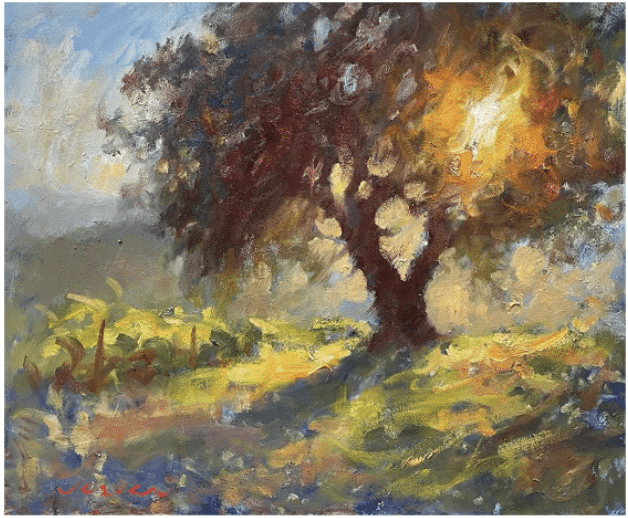
Ryan Jensen, With a Tree at Sunset, oil 20 x 24 inches
No! An athlete is someone dedicated to the idea of excellence. Every athlete is a work in progress; they strive for physical perfection even though they realize they’ll never achieve it. “Perfection is terrible,” says the poet Sylvia Plath, “because it cannot have children,” meaning that perfection implies an end beyond which there’s no need to go and nothing else to do.
So it’s good that there’s no such thing as artistic, musical, athletic, or physical “perfection.” The whole point of breaking a record is to move the goal posts further back. By its very nature, perfection is useful as something to strive for only so long as it remains out of reach.
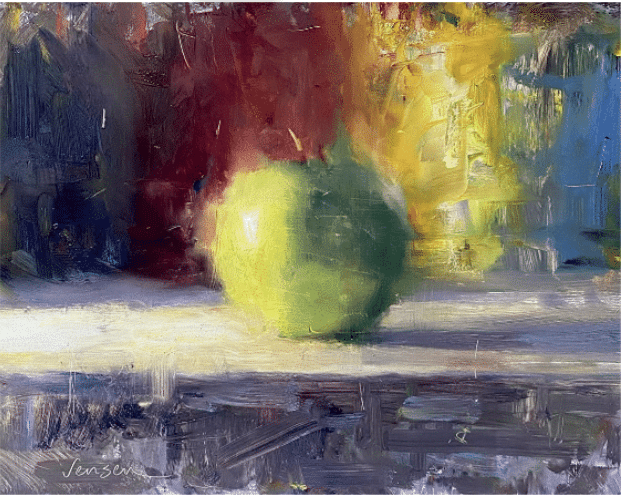
Ryan Jensen, Green Apple Dream, 12 x 16 inches
Similarly, artists are people dedicated to the idea of creative achievement. Artists, like athletes, never stop learning, training, working, and aspiring to an unattainable ideal. It’s why they’re usually the first to tell you just how far their work falls short of their goals, no matter how accomplished and successful they seem.
“Real” artists never stop learning to paint. And everyone, no matter how famous or unknown, is doing the same dance of trying to bring as much technical skill as possible to bear on the cultivation and expression of personal imagination and emotion.
The problem clarifies when you’re at a party or some social gathering and someone asks what you do. If you live in America, because of the way our society is set up, we all immediately start talking about what we do for work, which is to say, how we make money. I’m told that most of the time, that conversation does not go that way outside of America and the UK.
How much more interested in someone you meet at a party would you be if during small talk you didn’t hear someone say, “I work for This or That Company,” and instead learned they’re “trying pastels to see what they can do with them”? Or playing guitar sometimes. Or renting a cello and taking lessons…. or they just bought a kayak and they’ve been taking it out at dawn when there’s still a thin layer of mist over the water.
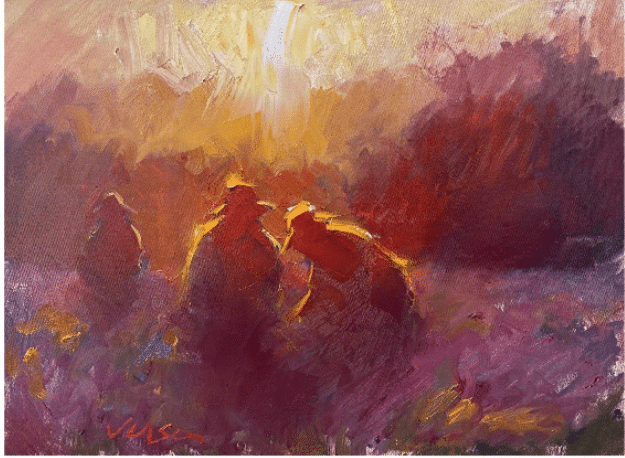
Ryan Jensen, Harvesting Lavender at Dawn, oil 18 x 24 inches
Everyone, professional and beginner alike, wrestles with the same two components – technique and a personal vision. Instruction and constant, careful practice make sophisticated expression possible while honoring the sources of your creativity makes learning technique easier. The two can advance together. Because, when you respond to something “out there” – a face, a landscape, the fall of light on a leaf or a bowl of fruit – you are responding to something “in here,” within your mind and heart as well. That is what you really want to paint – not just what it looks like, but also how it feels to look at it.
The more you pay attention to and value what moves you, the more your art will begin to express your unique personality (maybe personhood would be a better word). And the more you get in touch with and seek to communicate what moves you as an individual – what concerns you, what intrigues you, what you believe is true, what you find arresting, fascinating, beautiful in the world – the more you acquaint yourself with who you really are. In this way art becomes a tool for self-knowledge and personal development.
Effectively communicating personal vision – that which, for you, lifts the ordinary to the remarkable: That’s the mission. What’s often meant by “expression,” a word that can be vague and confusing, is often simply this – the attempt to express in paint what made you want to paint a thing in the first place.
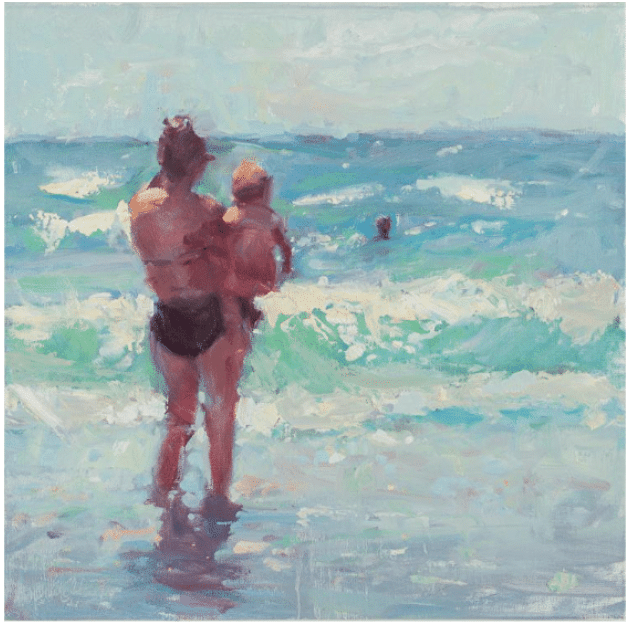
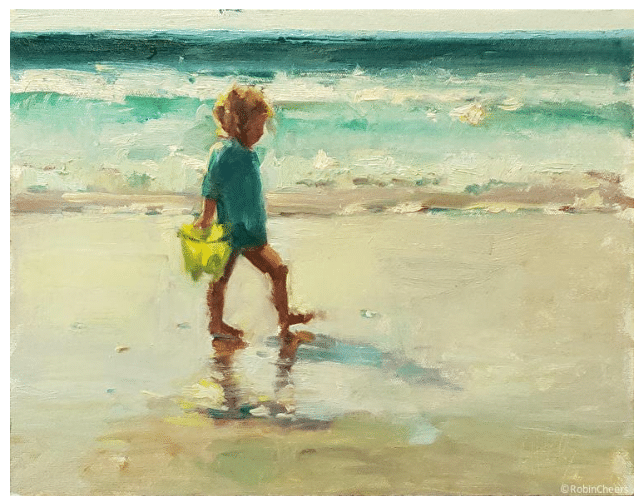
Robin Cheers, Watchful Eye, oil, 11 x 14 inches
Paint THAT, with whatever skill level you have right now, and you’ll find yourself excited to learn more. If you are someone striving to make good art that means something to you and to others, then you are an artist.
And maybe the next time you’re asked, “so what do you do?” instead of sheepishly ticking off what you do for your job, you could say, “I work at x … but I’m also an artist – or trying to become one anyway. I’m learning to paint.”
Today’s Inside Art features the paintings of Ryan Jensen and Robin Cheers, both of whom are sought-after teachers as well as true, passionate artists. If you’d like to loosen up your paintings and free yourself from worrying detail work, you may be interested in this bundle of two videos – Robin’s Brushwork Secrets UNLEASHED and Ryan’s Loosen Up available together at a special price.