
On gray mornings, when a mist erases the definitions of things, the merely odd can seem monumental and the familiar strange.
Van Gogh’s ox cart lumbers out of this indeterminate between-space of mist and fog with a precarious balance paired with an earthy solidity that recalls both Francois Millet, the originator of the French Barbizon style, and the Spanish old masters. Curators have seen in it the first inklings of the great artist van Gogh would become.
Millet and the other Barbizon artists painted life as real people lived it on the farms and the country towns outside the big cities. At the time he painted The Ox Cart, van Gogh had just moved back in with his parents in Neunens, the Netherlands, returning like the proverbial prodigal son after a failed attempt at being a minister.
He’d taken it into his head to save the souls and comfort a large group of destitute coal miners encamped in Belgium. The official church didn’t jive with his all-in version of self-appointed ministry, which was to behave as if he were Jesus Christ Himself. This skinny Dutch kid just showed up, gave the miners all of his money and what little else he had, including nearly all of his clothes, sleeping on the bare ground of an abandoned hut, dirty, shivering and often near-delirious and ultimately saving so one.
However, while his time wound down among the miners, he’d begun drawing his surroundings and thinking of a different life, perhaps that of an artist. He wrote to Theo in his last letter from the mining camp on September 24, 1880, “I don’t know what I can do, but I hope I shall be able to make some drawings with something human in them … The path is narrow, the door is narrow, and there are few who find it.” He, for one, despite his life being actually a total failure, would have the courage.
It was 1884. Still in his mid-twenties, he’d already failed out of numerous jobs. He was suffering, lost, and yet determined to make something of his life. He described Neunens and the northern part of the Netherlands in a letter to his brother Theo like this: “Out of doors everything is mournful. In fact the fields consist entirely of patches of black earth and snow; on some days one seems to see nothing but fog and mud; in the evening the red sun, in the morning crows.” Hence, the painting, Cart with Black Ox.
Cart with Black Ox was donated in 2007 to the Portland Art Museum in Oregon. At the time, curator Bruce Guenther pointed to, “the way the wheel becomes a definition lifted off the surface of the painting with the brush,” as an early emergence of van Gogh’s future style. How van Gogh painted the spokes, he argued, “is Van Gogh establishing his vocabulary as a painter. He becomes Van Gogh here.”
It’s distinctly different from the way he handled the wheels in the related Cart with Red and White Ox, also painted in 1884 (below). In both paintings, it’s as if his imagination has entered the motif and rendered the blunt essence of objects humanity uses to wrest basics of survival from a harsh, indifferent earth.

Van Gogh, Cart with Red and White Ox.oil, 57.0 cm × 82.5 cm (22.4 in × 32.5 in)
The black Ox Cart, though, has a whole other realm of expression in every inch of its artfully deranged form and stark, monochromatic treatment. Maybe we can see, when we compare the two, what the curator meant by how, in the black, foggy version (left, above), “he becomes van Gogh.”

Studying and copying the works of other artists is part of the training of any painter. Van Gogh deeply admired the Barbizon painters, and especially Millet, for their humility and lack of pretension or self-importance. Van Gogh responded to the way they lifted up the humble, the poor, the common lot of humanity in their work, as he felt compelled to do as well, first in his failed work as a missionary, and then in his paintings.
When van Gogh moved to Paris to live with his brother in 1886, he made some 40 copies of work by Millet.
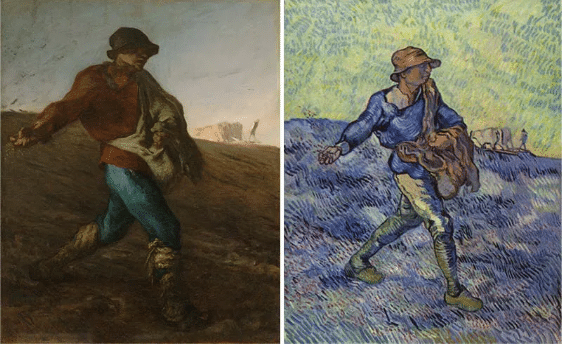
Left, Millet’s The Sower, Right, van Gogh’s copy in his own emerging style.
Millet’s work laid groundwork for the 19th century Realist movement in France. The term in this case did not refer to technique, as it does for us (e.g., realism vs. abstraction). At that time, Realism meant unidealized depictions of France’s working class, the grit and squalor of the the real life of the masses. As a visual critique of the stark social and economic inequalities of industrialized society, it naturally appealed to van Gogh’s passionate sense of art’s role in society.
Among the coal miners, van Gogh had seen – and actually, intensely lived! – the grittiest of the gritty realities of 19th century society. And yet, van Gogh’s art went far beyond Realism. One of his “sower” paintings shows a resplendent sunrise turning the field, the birds, the farm and its worker – everything – into something on the level of a church mosaic crafted of fractured gems and beaten gold. Van Gogh’s genius included his time’s truths yet, despite his own suffering (or perhaps because of it), lifted the genre from specific cultural critique into the realm of the spiritual and the transcendent.
His work is for all time.

Vincent van Gogh, ‘The Sower’, June 1888, oil on canvas, 64 x 80.5 cm, Kröller-Müller Museum, Otterlo (detail).
Poet Giovanni Pascoli seems to capture the grayness of Van Gogh’s Neunens as it appears in his description to Theo and Cart with Black Ox:
….
Down I stared,
but I saw nothing, no one, looking back.
The reveries of ruins asked: “Will no
one come?” The skeletons of trees inquired:
“And who are you, forever on the go?”
I may have seen a shadow then, an errant
shadow, bearing a bundle on its head.
I saw—and no more saw, in the same instant.
All I could hear were the uneasy screeches
of the lost birds, the yelping of the stray,
and, on that sea that lacked both waves and beaches,
the footsteps, neither near nor far away.
–Giovanni Pascoli, excerpted from “In the Fog”
There’s an excellent video on how to paint in van Gogh’s style by Dena Peterson called Loving van Gogh. She’s one of the artists who illustrated the extraordinary movie, Loving Vincent. Check it out here.<<