“You’re glowing!” When’s the last time you heard those words?
Yeah, me too. 😏 But thankfully, making your paintings glow is less a matter of accumulating poor life choices than knowing how to control value and temperature, whether in luminous brights or “low lighting conditions.”
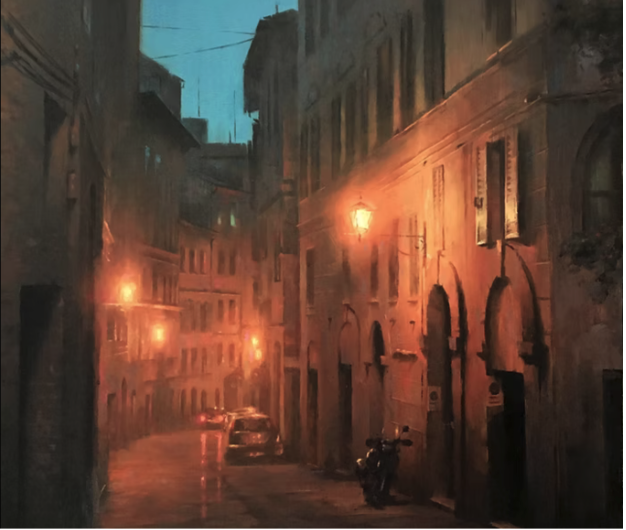
The detail above from Gavin Glakas’s painting, “An Appointment in Sienna,” illustrates this well. If we remove all the color with a photo editing tool, you can better see how what the values are doing. And values are where it’s at.
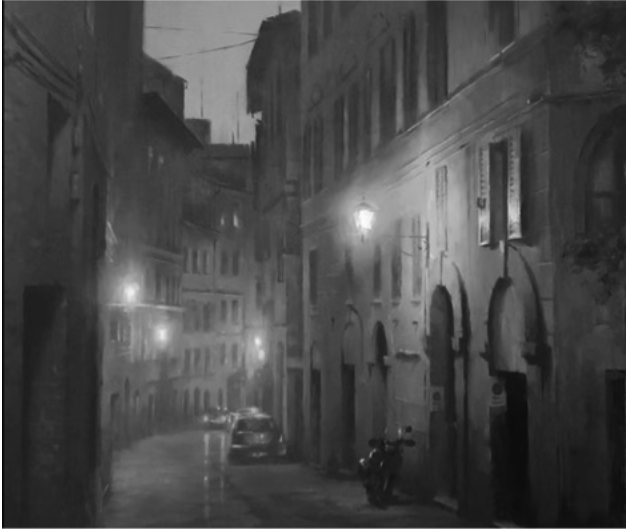
Desaturated: Gavin Glakas, “An Appointment in Sienna,”
As you can see in the desaturated version, we get some of the glow with or without color because of the careful modulation of edges and values. There’s a strong soft-edged contrast between the lightest lights of the streetlights and the midtones of the scattered (“ambient”) light on the walls.
A few “darkest darks” (and they do get quite dark) are there in the doorways, windows, and shadows. The “glow” is a matter of weighting the image in certain areas with these very dark darks, creating soft “atmospheric” transitions, and delicately managing the midtones so that the bright lights still read as bright.
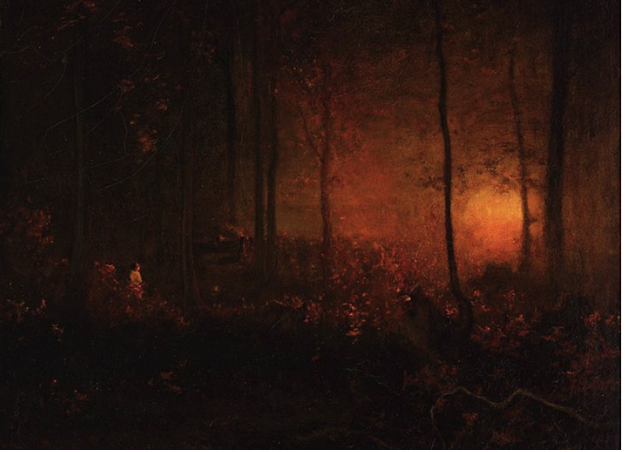
Detail: George Inness, “Watching the Sun Glow,” oil on canvas, 1887
Light source luminosity and high contrast between the darks and lights will give you drama, but to get that glow you’ll need some part of the light and shadow softly transitioning while staying firmly in the mid-tone range. “Infinite” gradations of tone – hence Tonalism. That’s why the painting by George Inness above works so glowingly. That and the limited stronger contrast achieved with the backlit trees and the bright setting sun. You can see it at work in a more overall-illuminated way in the landscape by Gavin Glakas below.
For Glakas, the golden hour is not just a time of day — it’s an emotion, a feeling that beckons to be captured on canvas. It’s the challenge of grasping that ephemeral glow, the interplay of light and shadow, and the profound serenity that it invokes, that makes it worth chasing
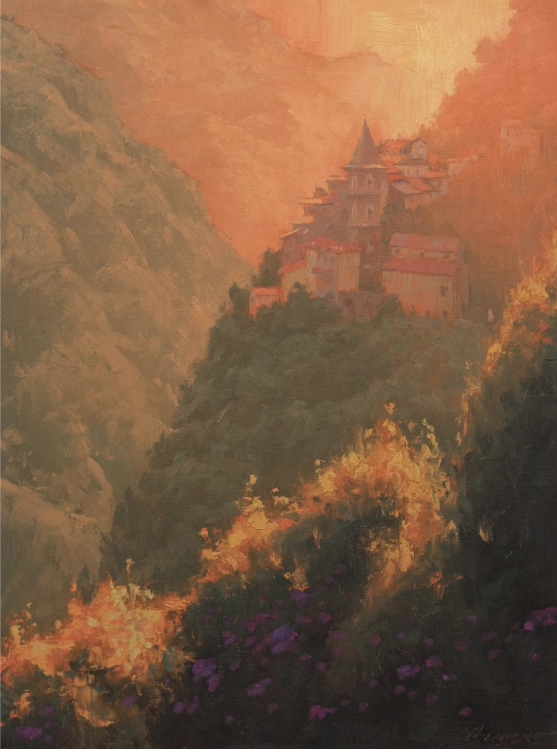
Glakas teaches his technique in his video titled “Glow: Creating Depth, Atmosphere, and Vibrant Sun.”
The rest is color temperature. And this introduces another kind of glow – color luminosity. When a warm and a cool color of the same or very close values sit next to each other (like the pale cool blue and warm orchre-tinted clouds in the sky in the painting below) you get a lively play between them sometimes called “vibration” – because the values are so close, the color contrasts mix and bounce optically, in the eye. The Impressionists called it “broken color.”
This technique also relies on values and gradients to create the illusion of light but then brings two or more contrasting (warm and cool) colors together so they appear to shimmer in imitation of the sparkling quality of light.
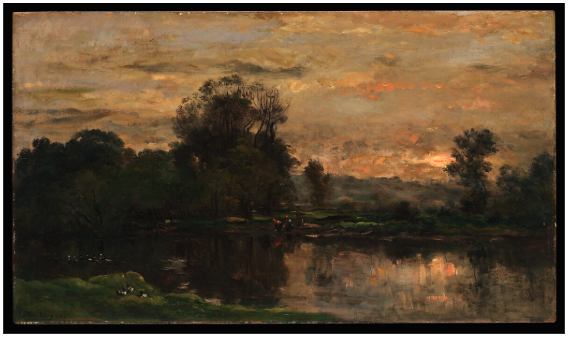
Charles Daubigny, “Landscape with Ducks,” Oil, 1872
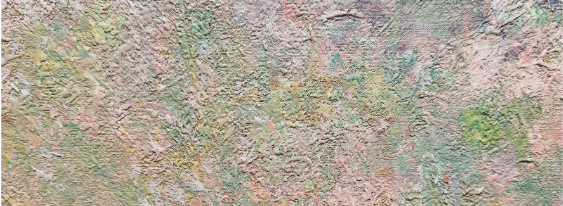
The technique in landscape was pioneered in the mid-1800s by French Barbizon painters like Charles Daubigny and perfected by the Impressionists. In the below detail from a Monet painting of a grassy hillside, he creates a luminous shimmer in his ground not based on value differences but by contrasting a multitude of warm and cool hues of similar or equal values.
Below is a painting by John MacDonald that’s “got the glow” using color luminosity. In his teaching, MacDonald demystifies the process with a simple formula: “Keep 90% of the values in the middle range and then punch in a few darks and highlights.”
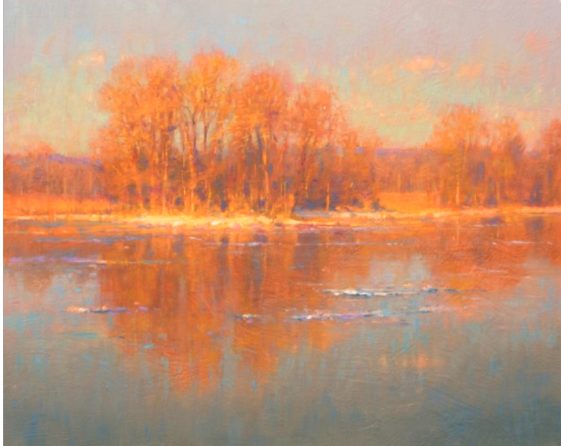
John MacDonald, “Last Ice on the Hudson,” Oil
“So many of the Tonalist paintings are beautifully luminous, a result of keeping the value structure simple (two or three foundation values) and limiting the range of their secondary values, which enabled them to push color contrast and create the vibration that imitated the glow, the opalescence, of a subtle but shimmering light,” he says.
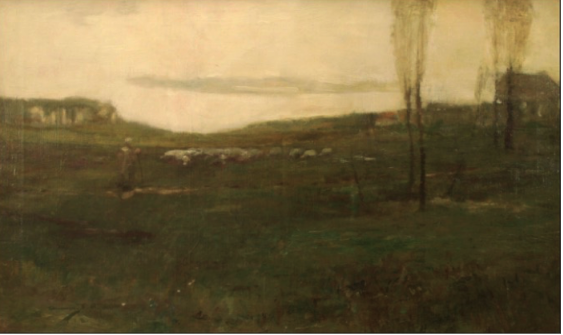
Tonalist Chauncey Ryder, “French Landscape,” Oil, c. early 1900s
MacDonald lays out his technique in his video, “Mastering Values.” Check out his blog for a deep dive in two parts all about “Getting that GLOW.”