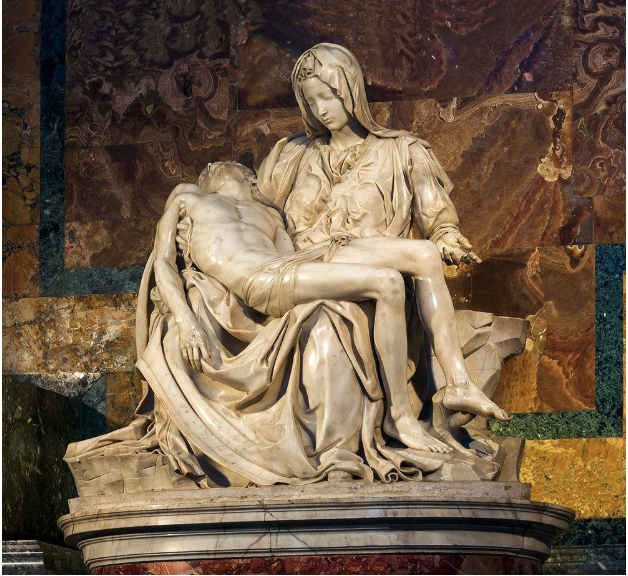
I was in my element, but I had no idea what was coming. We were on vacation in Rome, walking through the Vatican Museum because we couldn’t see the Sistine Chapel that day. And there was Michelangelo’s Pieta, the famous sculpture of the Virgin Mary cradling the lifeless Jesus, in its little alcove in Saint Peter’s Basilica. Though it was thronged by tourists four or five people deep, I wanted a look.
Turns out there’s a reason thousands of people have been coming from all over the world, every single day, for hundreds of years, just to stand and look, or rather to be in the presence of this artwork. And when you are there, you understand why, in a totally self-evident way. You will not fully grasp this unless you too find yourself there, in the presence of – in no reproduction, no matter how virtually real, will any great work of art fully reveal itself to you. Only in person. And therein lies a key to art and why artists make it.
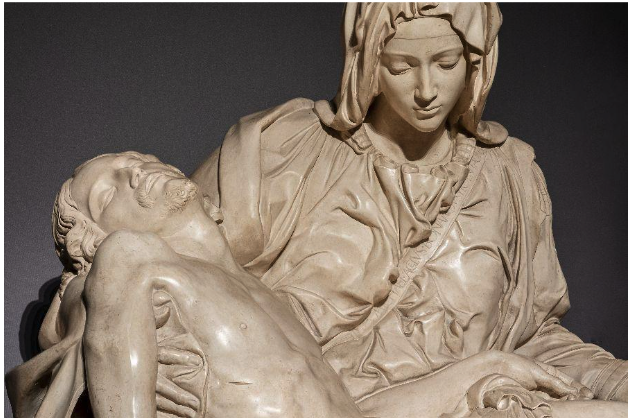
Although I flatter myself I’d score somewhere near “very” on the “familiar-with-the-Bible” scale, I confess it’s currently more about art than faith at this moment in my life. So, it took me completely off guard – the impact of this holy Virgin Mary with Jesus rooted me to the spot. Time disappeared. I stared, probably open-mouthed. Mysterious forces – huge waves or wheels of thought and emotion – churned inside my head and heart. My wife had to tell me were moving on and I needed to make room for the next person. I was left thinking, what just happened and why?
Art is about feeling. Moments like this, being in the presence of great art – Monet at the Orangerie Museum or at MoMA, Turner at Tate Britain, Rodin in Paris, Goya in Boston, Anselm Kiefer in St. Louis – these rare encounters have taught me that art really is about feeling. However, by “feeling,” I don’t think we just mean emotion. It’s emotion allied with ideas conveyed in a physical-psychological embodied way.
What was happening can be stated in a sentence: Standing in front of Michelangelo‘s Pieta in the Vatican, I felt the sculpture radiating the primary importance of love and healing and care in the face of the entire history of human longing, beauty, violence, and fear.
So it can be stated, but it cannot be felt. To put a high polish on it, I was being shown a vision of the anima mundi, the “soul of the world,” as the Latin phrase goes. Or was it lachrymae mundi, the “tears of the world”? Either way, Jesus was everyman and Mary was the world in mourning for all of flawed humanity. It was all of this, and none of it of course, all at once.
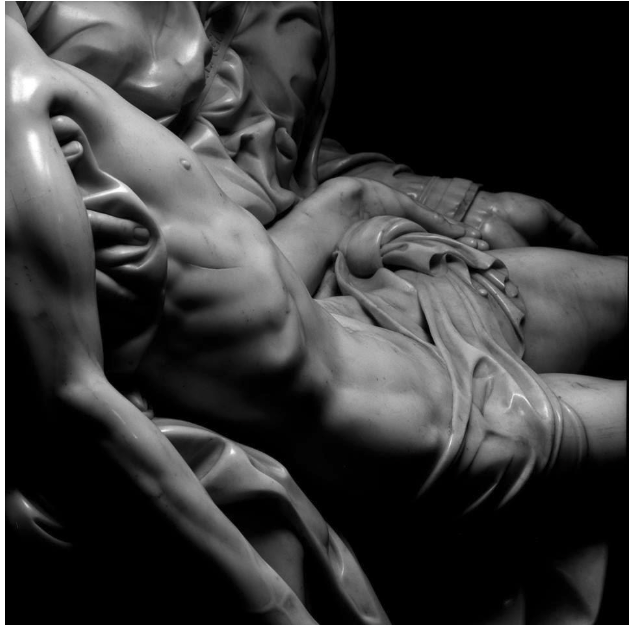
When you are there (not jut in Rome but anytime you’re viewing great work in person), when you are present, you feel the work of art as a CHARGED OBJECT. Every nuance of its surface crackles with significance as with an electric current. Present with Michelangelo’s Pieta, every curvature and angle, each shadow and gleam, reveals itself poetic with considered thought. You understand this chunk of rock has been transformed into a lightning rod by a mind passionate to embody a deeply felt adoration of both the material and the immaterial as they fuse in the crystalline luminosity of marble.
Great art makes us be present. It demands something of us. The greater it is, the more irresistibly it insists we listen. You cannot get this in an abstract, theoretical, armchair philosopher sort of way. It only becomes true when you are actually there and actually feeling it. Or not.
Can you be in the presence of great art and feel nothing? Of course. But why would you want to? True art will always meet an open heart halfway. If you’ve only an intellectual interest, that’s your thing. If you’re not interested in art at all, watch football. There is nothing wrong with that. But if you love art, gift yourself the opportunity to allow it to change your life: see it in person. Art’s electric current is available to practically anyone. However, like being a good listener, it requires our full attention and participation.
For anyone willing to experience it, Michelangelo’s Pieta is quite intimate. Many, I imagine, arrive as pilgrims of the Christian faith. Certainly Michelangelo considered himself a devoted servant of the divine. Art for him was a form of spiritual devotion; he viewed his artistic talents as a gift from God and his work as a means of revealing divine beauty. Whatever opens you to it, if you allow it to work on you, you will enter into the very inner life of loss, selflessness, and devotion, because, whether you have words for it or not, what touches you also feels vast, infinite, and impersonal, like an ocean.
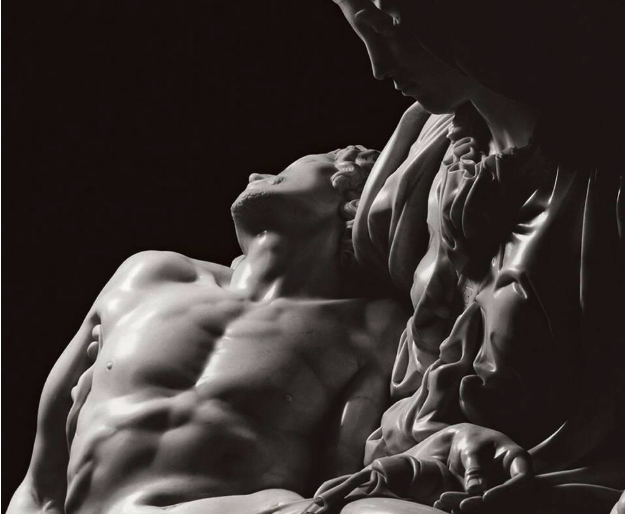
Who can describe grief as Michelangelo expresses it? Mary’s grief for her Son is full of vulnerability and pain but also massive, thunderous stillness and beauty. Michelangelo makes available to us the universality of personal loss married to Platonic idealism, the inner forces of inevitability, and the tremulous weight of history.
The entire thing is an argument for living more deeply and more fully. A great work of art sparks the briefly numbing astonishment that comes with any profound or extraordinary experience. There’s a tiny shock that such things even are and that suddenly we are living them, even as we understand the utter ordinariness of these things too. People make beautiful things, people murder each other, people die every day – deeply loved, even, with hearts big enough to save the world. And art remains.