
In this painting by Edward Gordon, we find ourselves in a fine, presumably Victorian house by the sea, perhaps somewhere on the coast of Maine. The open window looks out over a veranda overhanging the shore. In a lyrical and playful design touch, Gordon lets the colorful tideline run right across the center diamonds of the railing. The choppy ocean beyond ties to the title and the true, albeit invisible subject here – the eponymous “Wind from the Sea.”
To the right of the window, we can see a full-size reproduction of a famous painting by Vermeer. This is an inside joke on at least two levels – it’s Vermeer’s “The Astronomer,” and therefrom hangs a tale.

Johannes Vermeer, “The Astronomer,” 1668, oil, 50 x 45 cm. Musée du Louvre, Paris.
First of all, Gordon’s painting is very much in line with the Dutch interior tradition. In the painting on the wall, Vermeer’s “The Astronomer,”(above) a dreamy young man rises from his chair and lightly rests his fingertips upon a celestial globe (3D map of the heavens). Mild light filters through the window, softening his features. Behind him on the right side of the wall we find a painting of Moses (as Biblical leader and navigator) and on the left, an adjustable star map. There’s also a book on the desk, one page of which refers to divine providence. Vermeer’s subtle symbolism captures a time in history when religion and science remained in balance. It’s altogether a tender image, and like all of Vermeer’s paintings, deliberately poetic and open-ended.
Vermeer’s painting is linked to a second one for which he’s believed to have used the same model, this time in the guise of a geographer. Paintings of scholars in their studies were not unusual for this time, when Enlightenment science and philosophy were fascinating new frontiers of human knowledge.
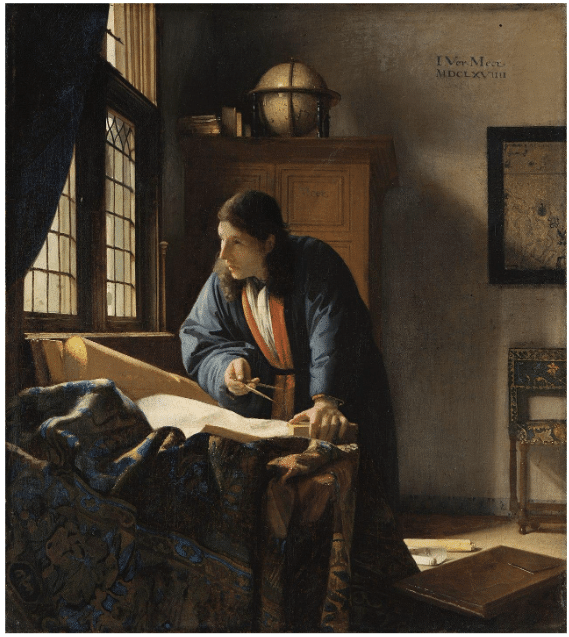
Johannes Vermeer, “The Geographer,” 1668, oil.
Vermeer’s “Astronomer” and its sister painting, “The Geographer” are thought to relate to an earlier painting, this one by Rembrandt, another depiction of a figure seated with globe before an illuminated window.
The Vermeer museum says this: “The posture of Vermeer’s geographer [as well as, I’d say, his “Astronomer”] mirrors, albeit in reverse, the figure in Rembrandt’s renowned Faust, an observation that goes back to Thore-Burger. This could suggest that Rembrandt’s piece served as an inspiration for Vermeer. While the moment the scholar [in all three paintings, actually] gazes out of the window in deep thought is exquisitely captured, the nature of his contemplations—both the questions he poses and the answers he seeks—remains enigmatic.”

Rembrandt van Rijn, “Faust,” 1652, etching
Vermeer’s work refined the motif of the contemplative realist interior. In Rembrandt’s, Vermeer’s, and Gordon’s paintings, the setting is a carefully rendered room with a hardbacked chair and an open window. However, art buffs would catch the other nuance here – Vermeer is famous for putting symbolically significant paintings on the walls of his own paintings. The framed picture behind the figure in Vermeer’s “The Geographer” is a map of the world, while the one in his “Astronomer,” as we’ve seen, is a star map.
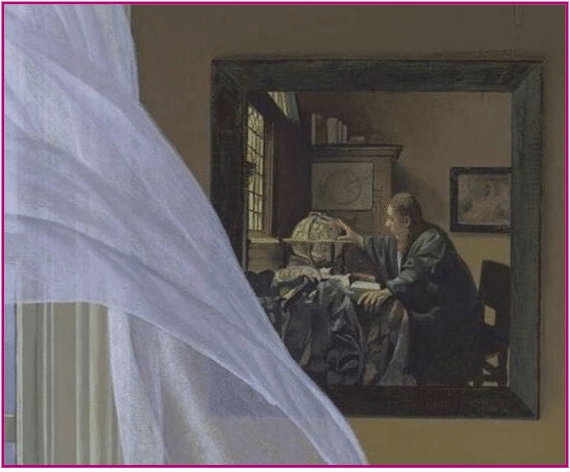
Detail of Edward Gordon’s painting at the top of the page, “Wind from the Sea.”
In Gordon’s painting, including Vermeer’s “Astronomer” serves as a tip of the hat to the Dutch master’s original ownership of precisely drawn geometric interiors. However, it also adds another shade of meaning; perhaps as viewers of Gordon’s idyllic scene, we take the place of the missing figure musing dreamily over the world outside the window.
About that Window
Gordon’s title (“Wind from the Sea”) refers to a painting by Andrew Wyeth of the same name, one that set the precedent for the “gauzy windblown curtain” motif. In a final, if perhaps more obvious twist, Gordon is paying homage to Wyeth by referring to the Maine artist’s own breeze-chased interior.

Andrew Wyeth, “Wind from the Sea,” 1947, 47 x 70 cm (18 1/2 x 27 9/16 in.). tempera on hardboard.
“Wind from the Sea” is an iconic example of Wyeth’s emotive landscapes, as well as one of the earliest examples of his use of windows and often unique choice of vantage point (this was an attic window). The subtle sense of time (mortality) in the sepia tones, the disintegrating shade, the dim, cracked wall and worn sills and jams – all contrast with the evident burst of air from the bright outdoors. Well-worn tire tracks outside lead toward the sliver of shore. In a final almost whimsical (surreal?) touch, a couple of the small, embroidered birds along the curtains’ edges seem ready to dart into the house.
So it is that, by way of a wide-ranging route indeed, we come home again to a simple (or not so simple) window.