Paul Cézanne was not a fast painter. “Nature presents itself to me with great complexity,” he once wrote — and his response to that complexity was to slow down, look harder, and build his paintings one careful layer at a time.
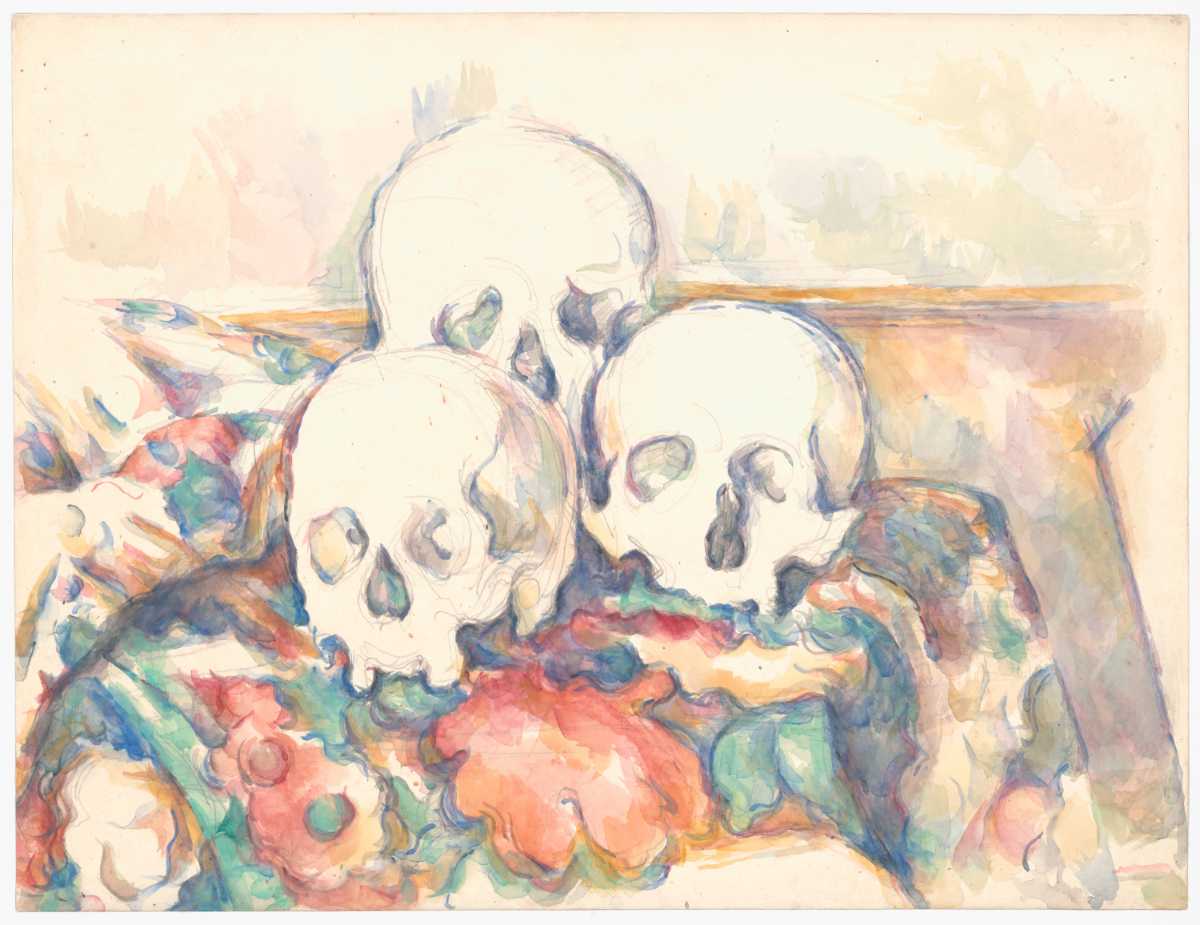
Nowhere is that process more transparent — literally — than in The Three Skulls (1902–06), a late watercolor now in the collection of the Art Institute of Chicago. The painting is a quiet masterclass in how Cézanne thought about seeing, structure, and the particular demands of working in watercolor. For painters in any medium, it rewards close attention.
A Process Built on Addition, Not Correction
Cézanne’s goal was never a flawless finish. He was after something he called réalisation — a sense of visual truth arrived at through ongoing adjustment rather than a predetermined plan. He worked incrementally, letting each wash dry before applying the next, building depth and atmosphere through accumulation. When something wasn’t working, he didn’t erase or scrub. He added. The painting’s evolution remained visible on the surface — and that visibility became part of its meaning.
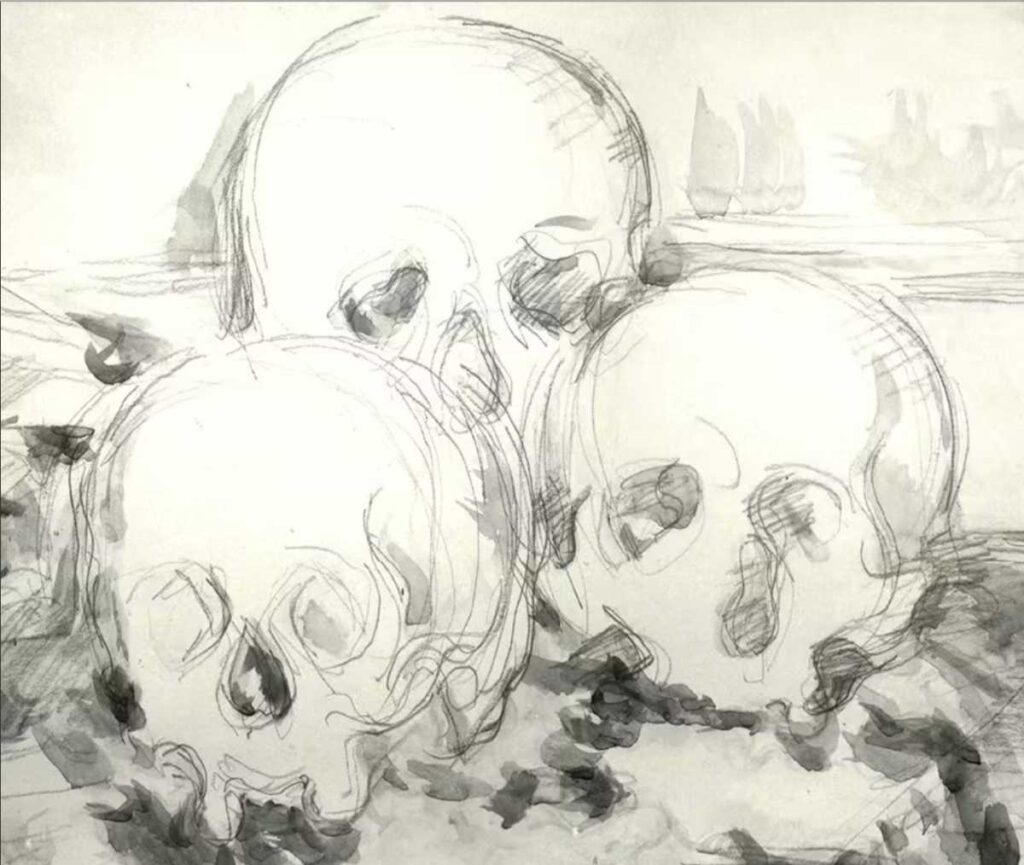
Cezanne established the major design elements—the skulls, undulating carpet, foliage in the textile pattern, table edges beneath the cloth, and horizontal chair rail—with repeated graphite lines that are more evident in the reflected infrared image of the work. Credit: Art Institute of Chicago.
He started The Three Skulls with a loose graphite framework — the skulls, the patterned cloth beneath them, the table’s edge, a horizontal chair rail. But the drawing was never buried. It stayed present throughout, sometimes reinforcing the painted forms, sometimes running independently of them. The productive friction between pencil and wash — structure pulling against sensation — is precisely what keeps the eye moving.
The Paper as Active Ingredient
One of Cézanne’s most instructive habits was his refusal to chase highlights after the fact. He preserved the white of the paper from the outset, treating the ivory sheet not as a neutral ground but as a luminous material in its own right. In The Three Skulls, it is the exposed paper — not heavy modeling — that gives the bone its rounded solidity and inner glow.
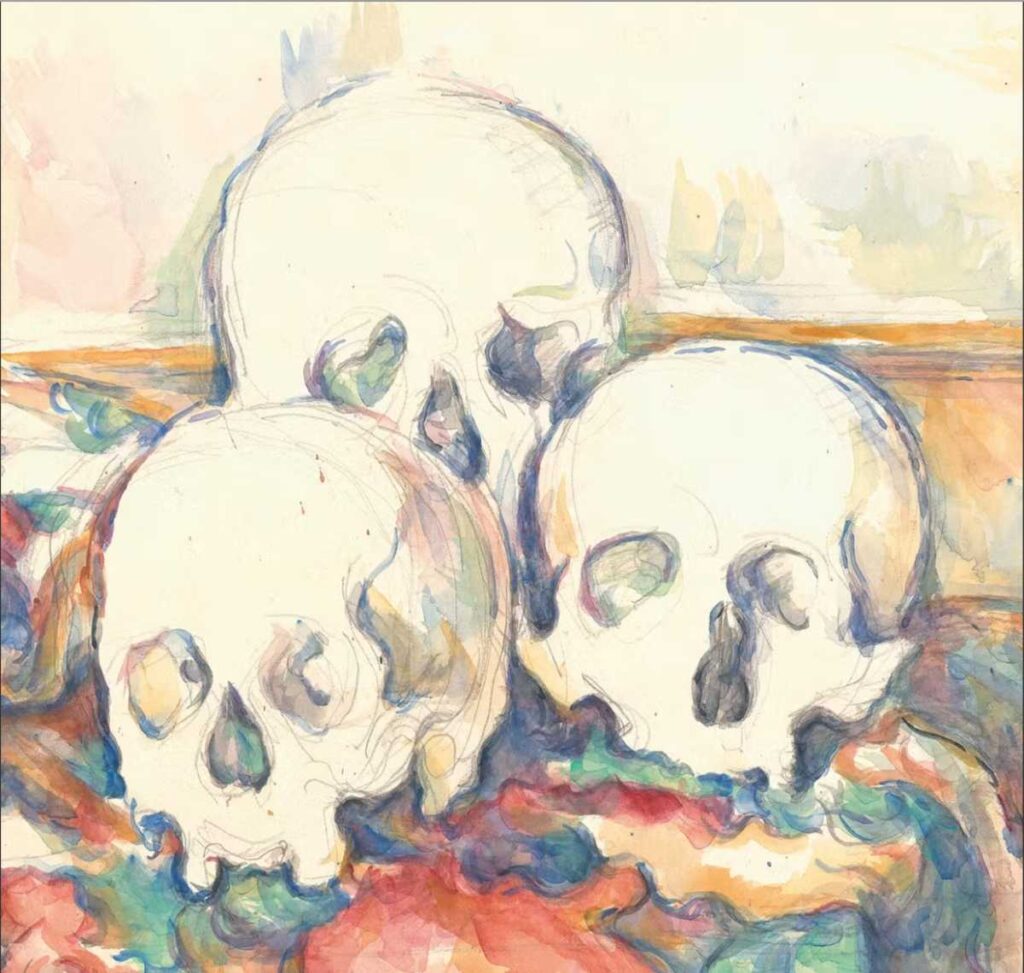
Detail of “The Three Skulls”
In the deeper shadows, particularly the eye sockets and the gaps between skulls, he reached for layered blues, especially indigo. But even these darker passages remain transparent. Cézanne believed that blue — introduced into reds and yellows — was what allowed a painting to breathe, to suggest air rather than simply objects in space. In this watercolor, blue functions as atmosphere as much as shadow, vibrating at the edges of forms and keeping everything slightly in flux.
The patterned textile beneath the skulls shows the full range of his layering strategy: transparent reds laid over and under more opaque passages, greens of varying intensity, punctuations of cobalt blue. Some strokes advance; others recede. The fabric doesn’t just sit there — it pulses.
Unfinished by Design
Cézanne also knew when to stop — or rather, when not to start. Portions of the background remain untouched. The textile’s border trails off. These deliberate lacunae aren’t failures of completion; they’re compositional decisions. The skulls feel simultaneously grounded and weightless, anchored by what surrounds them and released by what doesn’t. We’re reminded that we’re looking at a made thing, not a window.
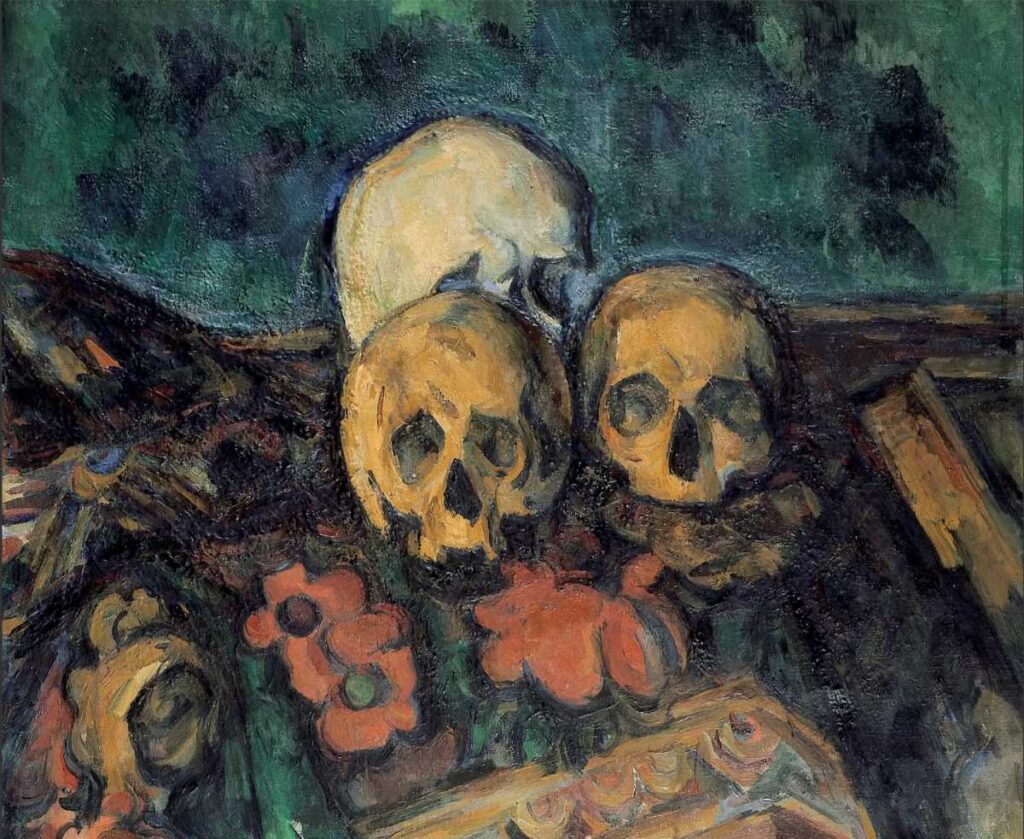
Paul Cezanne (French, 1839–1906). Three Skulls on a Patterned Carpet, 1904, oil on canvas; 21 3/8 × 25 5/8 in. Kunstmuseum Solothurn (Dübi-Müller-Stiftung), Switzerland, C 80.2. Photo: Paul Smith, July 2022.
Study or Finished Work?
For a long time, art historians treated Cézanne’s watercolors as preparatory studies — warm-ups for the oils. That view has shifted considerably. His late watercolors, many of them large and fully realized, stand as independent achievements. When he painted both The Three Skulls in watercolor and Three Skulls on a Patterned Carpet in oil, he wasn’t duplicating his effort. He was asking each medium a different question. The oil — dense, fully covered, weighty — explores physical presence. The watercolor, with its exposed paper and breathing shadows, explores the sensation of looking. Both answers are complete. Neither is preliminary.
What Cézanne ultimately pursued in his watercolors was what he called “a harmony parallel to nature” — not a copy of what he saw, but a painted equivalent of the experience of seeing it. More than a century later, The Three Skulls still delivers exactly that.
Follow in Cézanne’s Footsteps: The Secret Masters Know
Artists create boundaries and hit an invisible wall when they stick to just one medium.
- Watercolorists can feel timid about the medium’s unforgiving nature, producing paintings that look pale or washed-out.
- Oil painters can become rigid and formulaic, missing the freshness and sparkle that could elevate their work.
In “Seascapes in Oil & Watercolor,” Brienne Brown shows you how working across mediums doesn’t just double your skills — it multiplies them!