Each year, through a partnership with the renowned Art Renewal Center (ARC), we are asked to award a publication prize to one of the many striking and meaningful entries we receive in the annual International ARC Salon. This time, in addition to devoting a full issue to the winner, we decided to share a few that made it especially difficult to choose, and why.
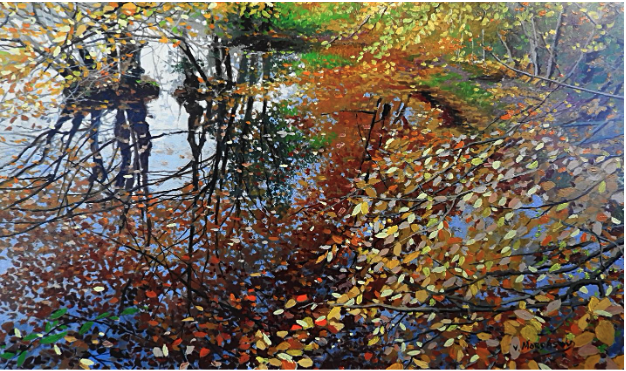
Victor Mordasov’s Whisper Through the Mirror of Autumn (above)
Pennsylvania artist Victor Mordasov had three paintings chosen as finalists in the Salon’s “Fully from Life” category. From our point of view, technique alone, however impressive, is not enough – there must be content and feeling too. It’s not just about how well can you paint it? but how well can you express why you wanted to paint it in the first place AND why should I or anyone else care? Mordasov’s “Whisper Through the Mirror of Autumn” answers those questions with a multicolored burst of motion, light, and dynamic form. Through the magic “mirror” of the water we get whispers of death in the spiky bare branches and life in acid greens. It wasn’t the only painting we received of trees reflected in water, but it was the only one so fully charged with genuine excitement: all those exuberant leaves strewn like confetti across the canvas explode complacency and invite to remember that rare and beautiful feeling: YES, I am ALIVE, I KNOW it, and life is good.
Alexandra Tyng’s As I Am
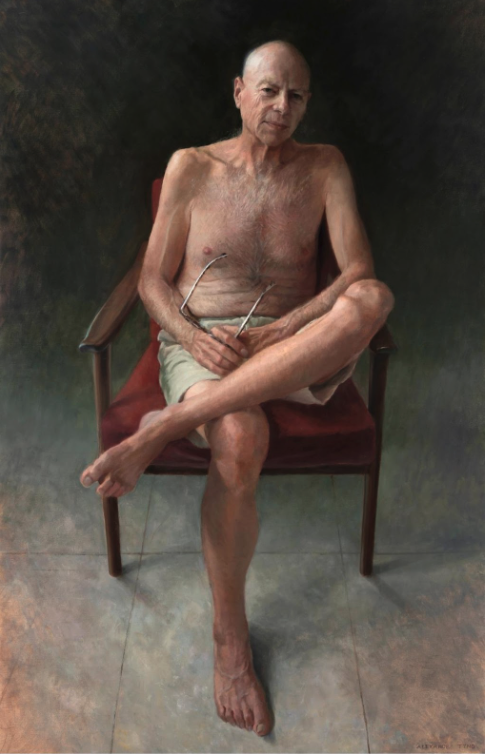
Alexandra Tyng, “As I Am,” 2025, oil on linen, 56 x 36 in. Courtesy of the 18th International ARC Salon
Portraits bring to the fore one of art criticism’s favorite academic terms, that of “the gaze.” The idea is that as we look at art, art “looks back,” in that it reflects its own truths about us, its viewers. Alexandra Tyng’s quiet, meditative painting, “As I Am,” struck us a raw, complex take on portraiture as reflection, acceptance, resignation, and recognition both of life’s tenacity and the frailty of the body. We appreciated the subtle sense of diminishment in the receding perspective, the enveloping darkness, and the minimal clothing. It’s a painting full of a pragmatic and unapologetic recognition of aging and exposure, all surmounted by the model’s sober and reflective stare. This painting puts realism at the service of honesty and vulnerability without idealization or fear.
Megan Elizabeth Read’s Spring
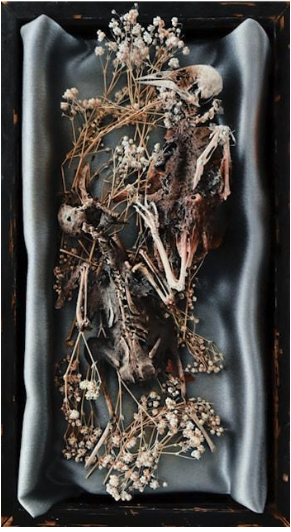
Megan Elizabeth Read, “Spring,” 2025, oil on linen, 10 x 6 inches. Courtesy of the 18th International ARC Salon
Here again we encounter the entanglement of life and death in a single image. Read’s “Spring” is founded on the long tradition of memento mori in still life but constitutes a strong departure as well. Spring is more elegy than exhortation – it presents a quiet contradiction: a still life primarily about decay, though framed in the language of renewal. The gray silk cloth is reminiscent of a coffin lining and therefore adds psychological and conceptual weight to the memento mori. And while the baby bird and the blossoms might normally suggest spring, the flowers are dried and the birds are skeletal. The scene feels delicate, tender; in the artist’s words, “more like a memorial than a memento mori.”
The artist’s statement says it eloquently enough: “The title contrasts with the subject, which was certainly intentional. Spring usually brings to mind new life and growth and singing birds, but here it’s about the quiet spaces in between—what must fall away to make room for something else. I don’t at all intend to shock, but to honor fragility and show how closely beauty and impermanence exist side by side.”
Emi Shigeno’s De Profundis
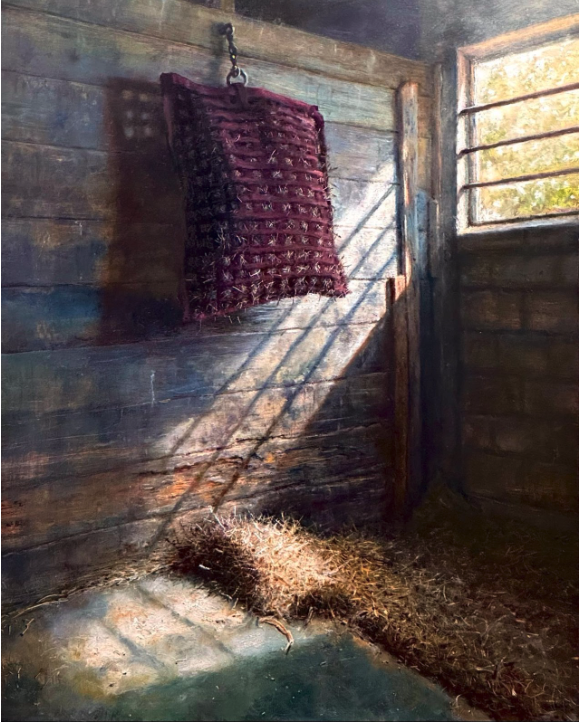
Emi Shigeno, “De Profundis,” 2025, Oil on wood panel, 16 x 20 in. Courtesy of the 18th International ARC Salon
Another contender from the Still Life category, Emi Shigeno’s “De Profundis” presents us, again, with a series of contradictions. As “a spiritual painter who loves poetry,” Shigeno says she’s “drawn to metaphorical depictions of the unseen world. Dostoevsky’s words to love every grain of sand, every leaf, every ray of light, and all the ugly … they have been my mantra — and so I’m drawn to the beauty I find in dirty, foul places such as a stable, with deeply religious implications. Light radiates even here, which I aspire to express in the most believable way.”
Ronilo Abayan’s Break of Dawn
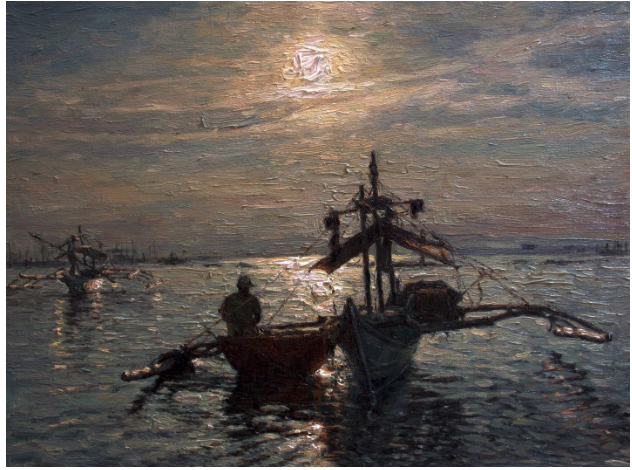
Ronilo Abayan, “Break of Dawn,” oil on canvas, 18 x 24 in. Courtesy of the 18th International ARC Salon
Ronilo Abayan’s “Break of Dawn” is solid, direct, and charged with an almost symbolic significance. All we get are the essential elements: a human figure backlit by gray water and smoldering light, and, raised above the tilted horizon, an unlikely tangle of masts and rigging. And that’s all that’s needed. In its own straightforward, unfussy way, “Break of Dawn” opens an unassuming window onto the human story.
Streamline Publishing hosts its own salon-style competition, the PleinAir Salon (which isn’t just for plein air painting). The monthly contest rewards artists with over $50,000 in cash prizes and exposure of their work. A winning painting, chosen annually from the monthly winners, is featured on the cover of PleinAir™ magazine. The deadline is ongoing, so visit PleinAirSalon.com.