We conclude with the final installment of “mountain tips” from three professional painters: Kathryn Stats, Tim Diebler, and this time, Paul Kratter. (View Diebler on brushwork here) and Stats on Color, here.
There’s one more aspect of painting the mountains that’s easy to overlook, and it’s because we’re mostly thinking about those beautiful complex colors and big, silhouetted shapes and peaks. The oft-forgotten ingredient is design, and it’s as important to a strong mountain painting as any other aspect of the process, if not even more so. Paul Kratter gives design the fundamental importance great mountain paintings demand.
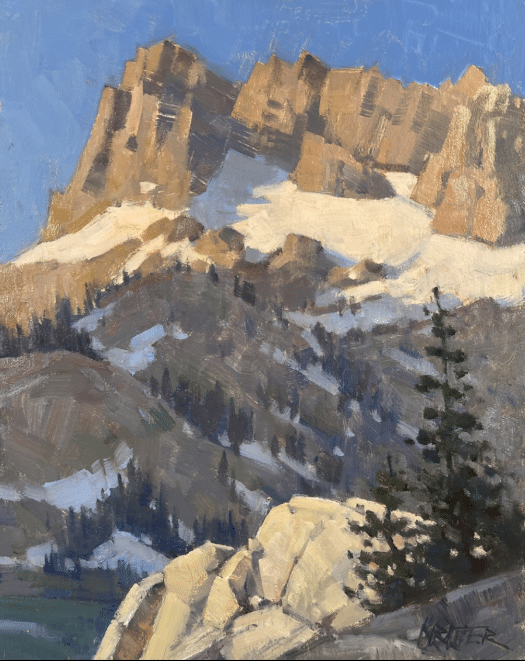
Paul Kratter, “Sunrise!” Oil on linen, 8” x 10”
Especially strong in design, Paul Kratter’s paintings skillfully compose light, atmosphere, and expression of emotion. Paul comes from an illustration background that instilled strong drawing and design skills and a robust belief in graphic shapes and storytelling. His compositions are always dynamic and often unique.
Take “Sunrise!” (above). This painting, by placing the perspective’s horizon line particularly low in the composition, makes the mountain come into its own strength and glory. Though the directional brushstrokes in the foreground rocks bring us in, the pockets of snow direct our eyes toward the summit, where the rising sun strikes the rockface like an echoing refrain.
We can trace out a more intricate design that underlies the composition by following the direction of the edges (also known as “lines”) and seeing where they travel and where vertical road blocks stop them.
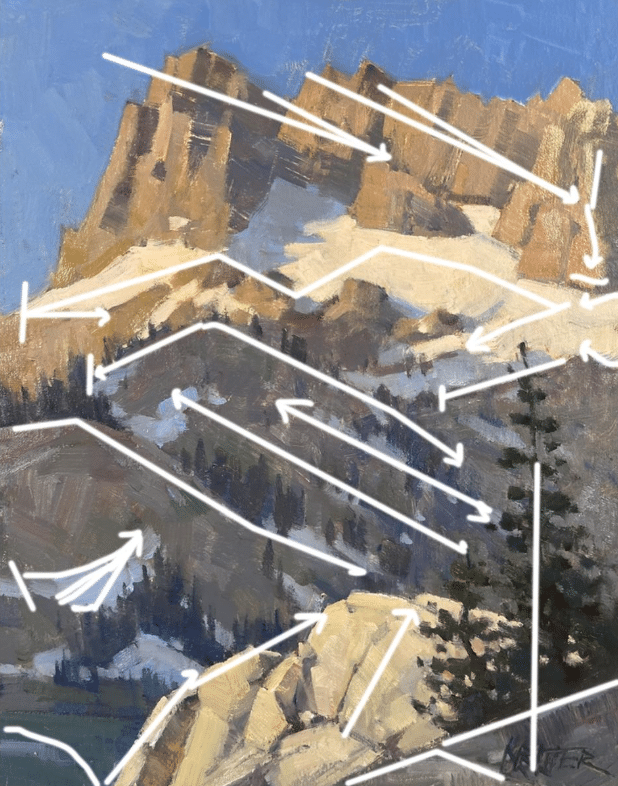
Strong design! Again, design here consists mostly in directional lines, that is, the edges of things, including both the rocks and such portrayed but also borders created by changes of color and value. Note how all lines lead across and back into the painting – nowhere does Kratter allow a line to point the viewer outside the picture. IIn the diagram above, the vertical lines are hard stops added specifically to prevent this from happening.
His secret? He takes the time to make a series of sketches first. Most artists completely skip the sketching phase, but in his video titled “Landscape Painting & Design,” Paul demonstrates how “sketching your way to success” ensures a strong painting at the end of the session. Read more about it here.
Try a Vertical
Kratter sometimes uses a vertical format for his mountainscapes. This creates accentuates the tall, soaring quality of mountains and peaks. It’s a marvelous strategy, and one liable to get attention at plein air events. Many people who have limited wall space in their homes will jump at the chance to fill a special niche with such a painting.
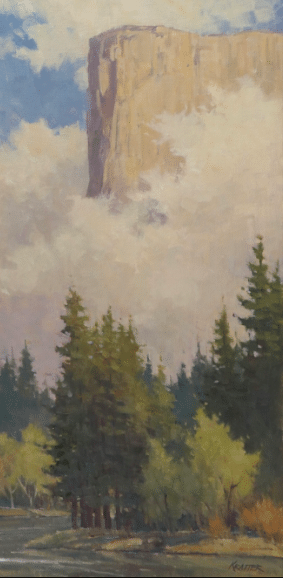
Paul Kratter, “Up Through the Clouds,” 20 x 10 inches, oil
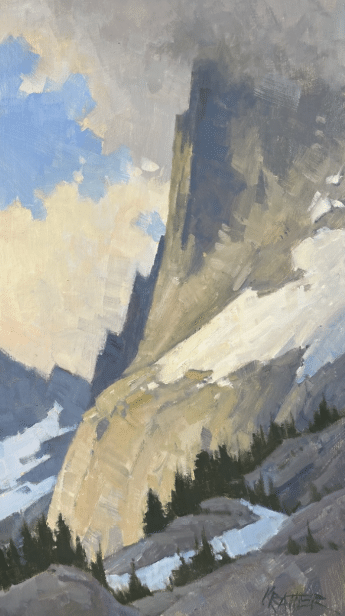
Paul Kratter, “Head in the Clouds,” oil, 14” x 8”

Paul Kratter, “The Valley Aglow,” 20 x 16 in., oil Note how the mountain ridges are used as directional lines, pointing the gaze toward the all-important sunlit stand of trees (the source of the title’s “glow”).
Paul Kratter’s paintings embody the light, atmosphere, and emotion that only an accomplished artist can convey. Paul, along with many experienced fine art painters comes from an illustration background that instills strong drawing and design skills and a robust belief in graphic shapes and storytelling. This is prevalent in Paul’s work as a skillful and accomplished landscape artist.
Paul Kratter
The Granite Group
In 2004, Paul and Bill Cone loosely formed a mountain-adventuring plein air group they call The Granite Group. Bill called Paul and asked if he would like trip and paint big granite in the Eastern Sierras. He only wanted to invite artists and to be able to paint from sun up to sun down and not cook or clean. He also wanted the gear portered up to one location and not have to move because the fishing was bad or move every day to another location. “I’m in!” said Paul and so it began. They’ve had nearly fifty artists join them from all parts of the United States.
“In 2015 on the last day of the trip as we hiked out from Garnet Lake (elevation 10500 feet) and we were just a half mile into the hike when on a steep trail I slipped, stuck out my left leg and all weight landed on my left knee & it felt like it exploded. I dislocated my knee cap and it ended up part way up my thigh. That’s not where it belongs and needless to say I was in a great deal of pain. Suzie Baker had a satellite radio and put out an SOS and the message back was it might take up to four hours to be rescued.”
“After five and a half hours a helicopter arrived to take me out. The search and rescue volunteer put me in a basket and the rest of my friends carried me step by step across a creek to where I could be safely hoisted up to the helicopter and flown to a meeting place where an ambulance awaited and I finally could be put on pain medication. Tia drove up to pick me up & we celebrated our 34th wedding anniversary with sparkling cider and some ice cream.”
“It is amazing to paint and enjoy the camaraderie one only gets from camping side by side for nearly a week in some of the best mountain scenery anywhere. To stand where Edgar Payne once stood and painted is extraordinary.” Paul exclaimed. This is where Paul coined his favorite phrase, “Nailed it”. He can often be heard yelling it when painting, which translates to, “I’m having fun!” We hope to paint into our seventies,” he says, “and then some of the younger artists can continue to carry the torch.”

One of the many Granite Groups
You can check out Paul’s video on design right here.