“Light is therefore color.” – JMW Turner
Painting, many people say, is all about light. Historically, however, painters treated light not just literally but as a visual counterpart of wonder, spirituality, and the sacred. We can approach the light in painting in many inspiring ways.
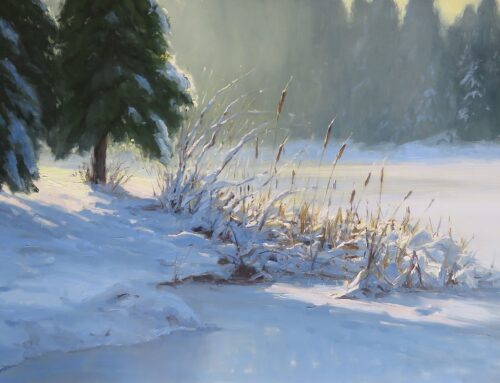
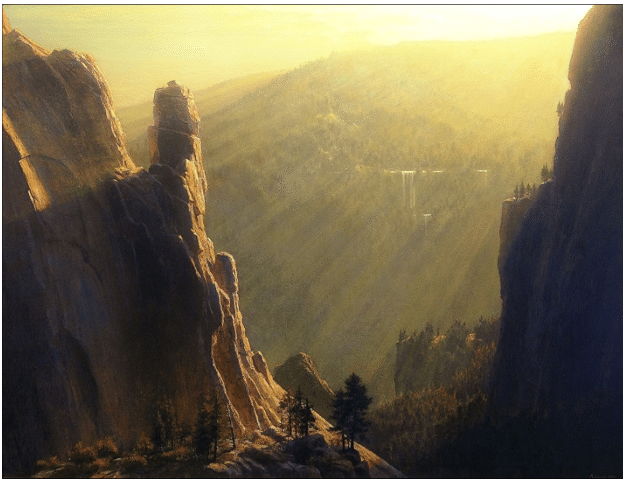
How can the light in Joseph McGurl’s painting “Light Streams” (above) fail to lift us to a higher level of consciousness if we remain open to it? The scale approaches grandeur, especially when you realize those are full-grown pine trees standing sentinel in the foreground. The diaphanous curtain of radiant light beaming from a brilliant source one might associate (consciously or unconsciously) with “divine light” beaming from the parting clouds of Heaven. Either way, McGurl’s light seems almost capable of dissolving matter; it’s otherworldly, “like the first morning.”
McGurl didn’t just paint a pretty view; this is an invitation to a vision of life illuminated – a grand immersion in the realm of the immaterial: a morning on which the world seems made anew, nothing but streaming light, sky, water, mountains, and trees.
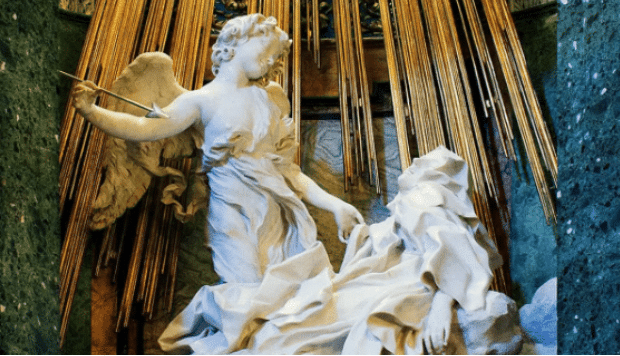
Heavenly light: Gold from God for Bernini’s Saint Theresa
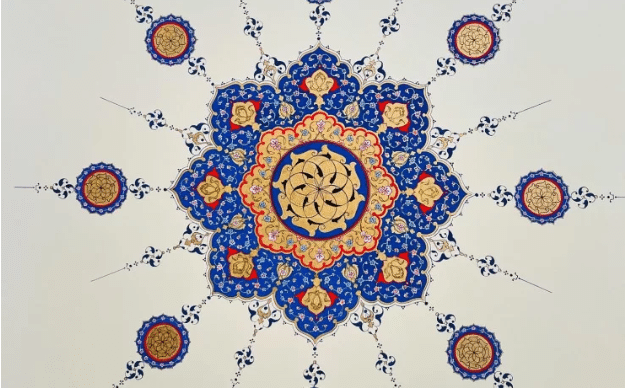
Divine Illumination in Islamic art
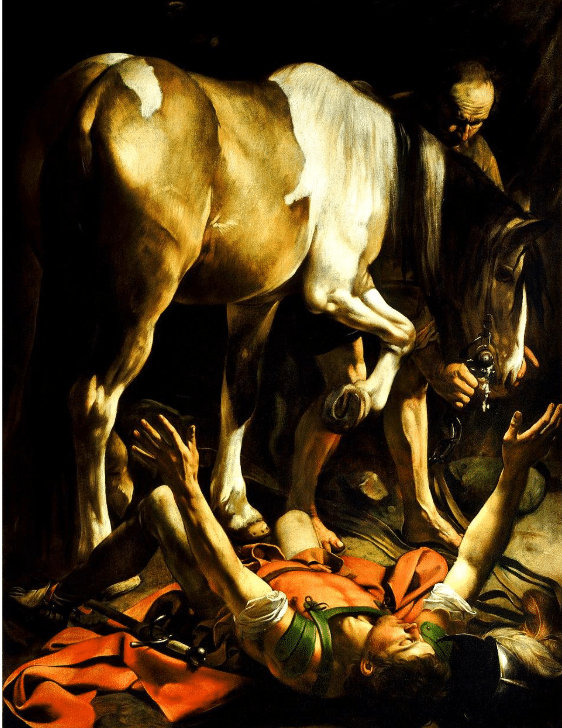
Caravaggio, “Conversion on the Way to Damascus” – Caravaggio’s use of strongly directional light exploding into the darkness lends his work its timeless religious quality, despite his use of non-idealized, “common” people (his friends from the streets!) as his models.
One of art’s jobs is to wake us from the stupor of workaday life and raise our awareness to a higher level, to open our eyes onto a new day’s light. For explicitly sacred light, we might turn to Joseph Mallord William Turner (1775 –1851). Turner uses oils in transparent glazes and warm-toned colors to express the Biblical light of Old Testament prophecies in his painting, “The Angel Standing in the Sun.”
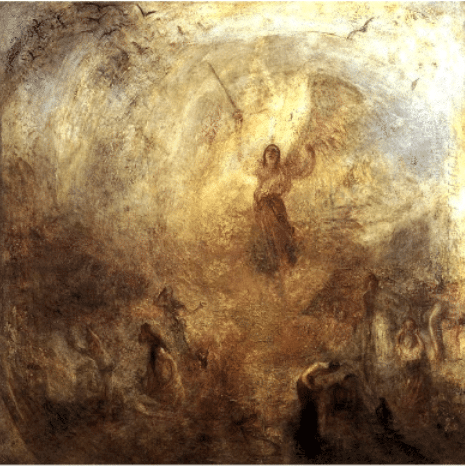
JMW Turner, The Angel Standing in the Sun, oil on canvas, about 24” x 24”
Turner based this relatively small painting, first exhibited in 1846, on passages concerning the “Day of Doom.” We see the archangel Michael, at the center of a spiraling wash of divine light, announcing the fiery destruction of our “fallen” world to make way for a new Heaven and a new Earth.
Turner’s contemporary John Constable (1776–1837) expressed a far subtler but no less keen sense of the spiritual through his use of light. Constable’s landscapes emphasized naturalism with almost realistic precision despite often being loaded with sentiment and symbolic expressions of religious faith. Constable’s Salisbury Cathedral from the Meadows, 1830, gives us an earthier sense of solid ground than either Turner or McGurl, but not without its own heavenly rays and a symbolic rainbow arcing over the heaven-pointing spire. The darks are saturated in a way that plays up the light from above rolling over the scene and making it glow.
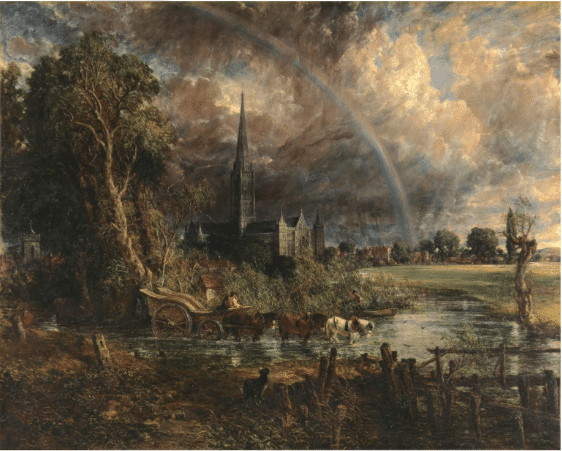
John Constable, Salisbury Cathedral from the Meadows, oil, 1830.
Constable pairs the cathedral with lush vegetation, cultivated meadows, and a country cart-driver under clearing skies; it’s his way of symbolically uniting God with man. As his contemporary, the Romantic poet William Wordsworth phrased it, “God’s in His Heaven and all’s right with the world.” Seen in person, says the Tate, you’ll notice that “fresh raindrops glint and sparkle on the brambles in the foreground” where a black and white sheep dog (a stand-in for the viewer) points our gaze directly toward the church with its skyward gothic spire, the tip of which clears the storm, backlit by the heavenly light.
Claude Monet set an example for plein air artists to this day by making the worship of light in his paintings almost itself a religious practice. According to the Tate, Monet’s Poplars on the Epte (1891) is known to be the artist’s favorite among a series of pictures he painted of rows of tall trees lining a bend in the Epte River. (We previously studied that series here and here.
In the summer of 1891 Monet learned that this row of poplars on the river Epte, near to his home at Giverny, were to be cut down. The artist paid for them to be left standing long enough for him to paint them. In all he executed 23 paintings of this scene, exhibiting a group of them together in 1892.
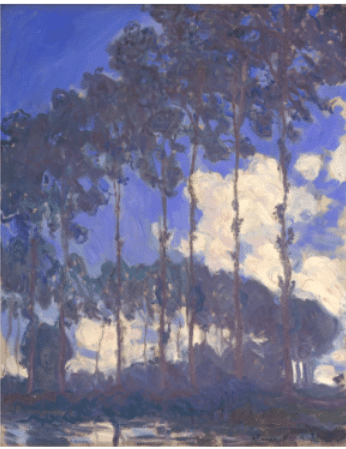
Claude Monet, Poplars on the Epte (1891)
Monet magnificently handles the light shining through the translucent clouds. The bold and dynamic geometry of the composition, paired with the luscious blues and the very free and active brushwork, renders a row of unwanted trees into an icon of heightened awareness, a testament to how beautiful our world can suddenly seem when seen with eyes open to its wonder and life.
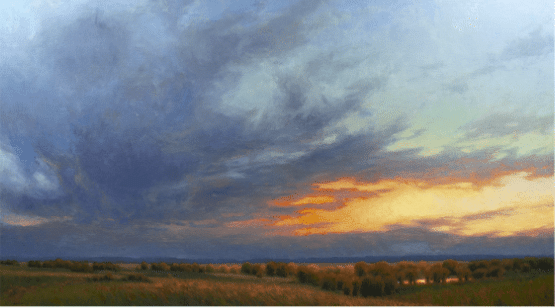
Kim Casebeer, Reverence, oil, 40” x 72”
Kim Casebeer is a contemporary artist carrying forward the notion of expressive, if not spiritual, light in 21st century landscape painting. In titling her large (40 x 72 inches) oil painting “Reverence,” (above), Casebeer connects a “big sky” view of North American topography with the sense of the sacred we feel when struck with awe by a religious painting or, indeed, a beautiful sunset.
Really getting light into a painting is a challenge for any artist. You may find it a good place to start with Kim’s demonstration video Dramatic Light