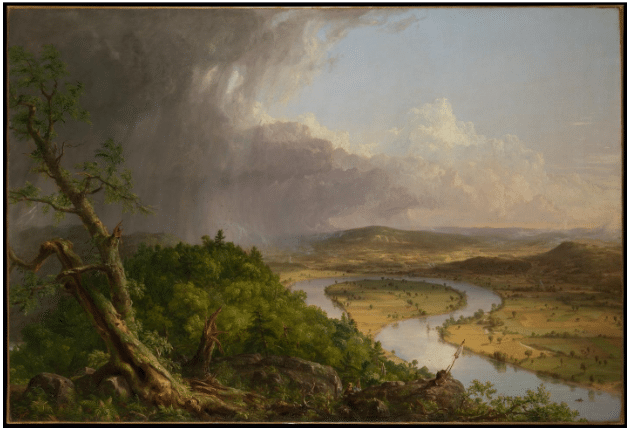
Considered among the most important American paintings, Thomas Cole’s 1836 “The Oxbow” is a manifesto, not just of nineteenth-century American art but for the social role that American art can still play.
England-born artist Thomas Cole (1801-1848) is considered the first great American landscape painter. His painting (above) titled “View from Mount Holyoke, Northampton, Massachusetts, after a Thunderstorm,” popularly known as “The Oxbow,” is perhaps also the most famous American landscape ever painted, largely because it is regarded as so beautiful. It’s often used as an example of the beauty and “harmony with nature” characteristic of the Hudson River School he inspired. However, look closer and you’ll see that Cole wasn’t just rendering a beautiful view; he was commenting on, among other things, the gradual destruction of the North American wilderness.
Cole’s painting introduced the “majestic” panoramic mode of landscape that would become the signature of his Hudson River followers. But “The Oxbow” is not just about landscape – it’s about time, metamorphosis, and the uncertain destiny of America itself.
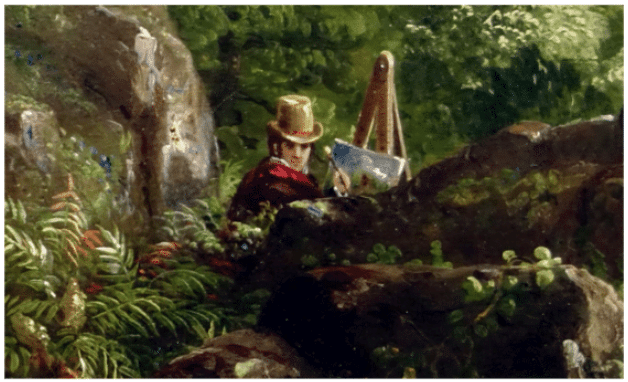
In addition to the many “hidden” meanings in this painting, Cole included a tiny self-portrait (it’s in the foreground, slightly right of center). But there’s much more of interest hiding here.
Zooming out to the whole painting, we can see that Cole deliberately divides the landscape diagonally in half. There’s God’s sublime creation on the left, storm-clouds, blasted trees and all, and on the right, cultivated, completely altered land, pastoral yet dotted with plumes of smoke from farmhouses and mills. Between the two halves he places the river – (an “oxbow” is a meander, where a river seems to backtrack on itself) – in the form of a question mark.
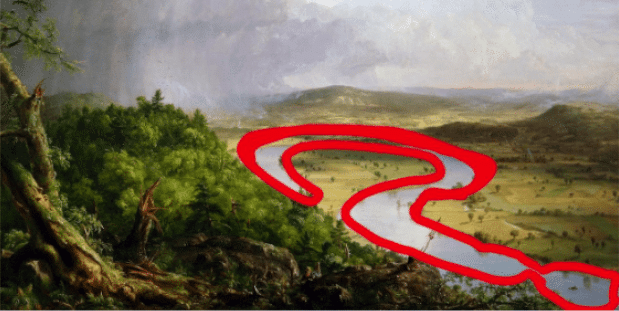
A question mark runs through it.
Nothing in Cole’s work is coincidental; his use of allegorical symbolism in his major paintings is well known. Why a question mark? Cole is registering his unease with the stark contrast and lack of integration between the “untouched, virgin land” (once emptied of its millions of prior inhabitants) and what “civilized man” is doing to it. Unnoticed for a hundred years, on the distant hillside Cole painted the three Hebrew letters that spell out the word for Almighty (Shaddai), the most frequently used and most reverential of the (pronounceable) Biblical names for God.
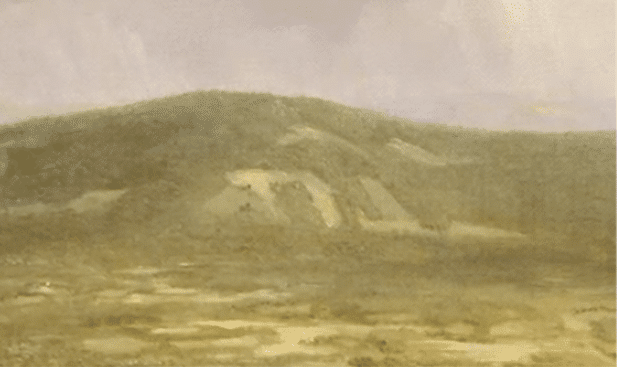
The slopes of the distant hillside, showing areas of clear-cut from logging – in the shape of the Hebrew letters. Although upside down and reversed, they spell “Almighty.”
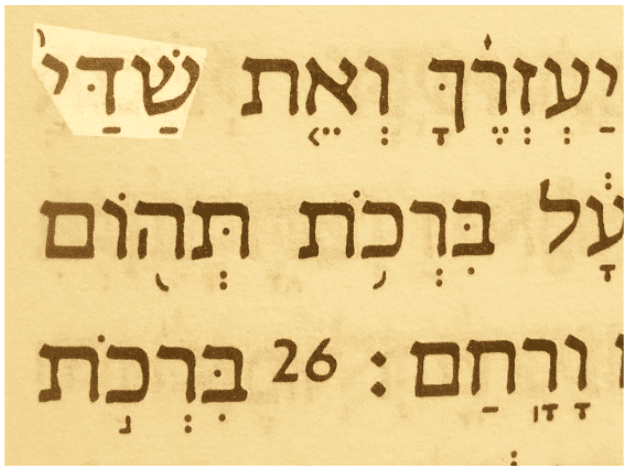
The Hebrew word Shaddai (Almighty) in the Hebrew text of Genesis 49:25
That Cole turned the “Lord’s name” upside down and flipped a letter backwards helped to conceal it. It also adds an extra shade of symbolism – these are logging scars, designed as if to say, “man carved these letters but imperfectly – so is Manifest Destiny really the will of The Almighty?” It’s not a stretch to imagine that the popular propaganda of the day (Manifest Destiny = God says we own this land from sea to sea) would seem suspect to a European-born Romantic already deeply skeptical of the “progress of man” (as we know from his writing and various other paintings).
Coupled with the question mark, it adds up to Cole asking: Are you going to preserve the sublime aspects of nature or are you going to destroy all of it? And if the latter, are you sure it’s really God’s will? Cole saw all civilizations as cyclical. You may well succeed, he would likely say, but for how long? (See our three-part series on Cole’s epic painting cycle, “The Course of Empire.”
Cole was born in the very heart of the industrial revolution, an English coal town so polluted that people had trouble breathing in the open air.
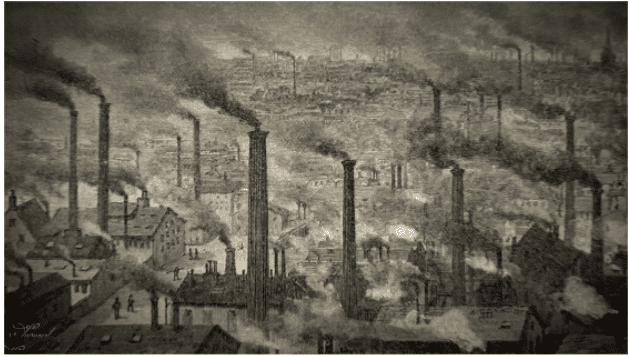
When Cole painted “The Oxbow,” the nation’s president was Andrew Jackson, known for his imperial style of governing, his support for slavery, and for the forced removal of Native Americans from their traditional lands. Cole hated Jackson and mocked him in another of his famous paintings, “The Consummation of Empire,” the third in his five-painting series “The Course of Empire.” That allegorical series (see link above) illustrates the rise and fall of Empires; it begins with an Edenic paradise and ends in downfall, with civilization in ruins, defeated by time and eternity, being reclaimed by nature. Cole completed it the same year he did “The Oxbow.”

Did it look the way Cole painted it? Yes and No. This is a photo from a stereo-view of The Oxbow from Mount Holyoke circa 1870. The river has shifted significantly, but Cole also rearranged perspective to suit his composition and his message.

The Connecticut River today, from a point on Mount Holyoke near where Cole made his sketches.
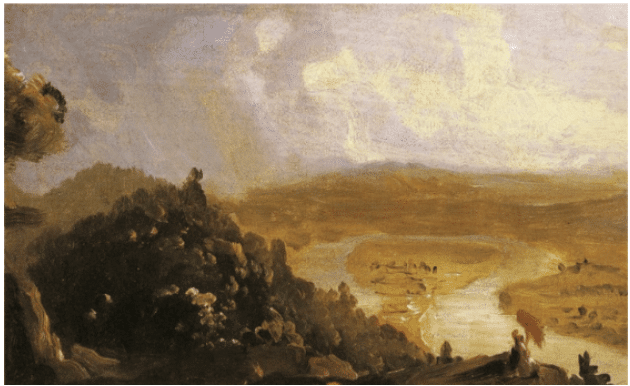
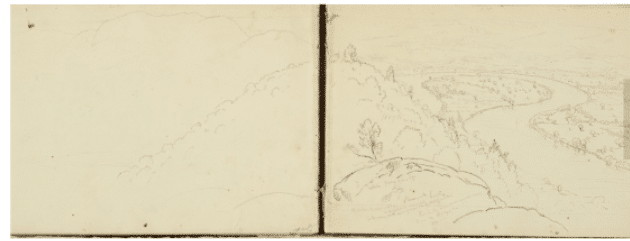
Cole’s oil sketch of “The Oxbow” (above) in which he created the question mark (not present in his pencil sketch below) by including a woman with a parasol.
Cole was a poet at heart, a master who leavened his paintings with meaning. Most of the Hudson River School movement that he inspired completely missed or ignored his work’s depth, but Cole loved symbolism, visual rhymes, and ambiguities.
To drive the point home even more clearly, Cole published, also in 1836, his “Essay on American Scenery,” a manifesto for why art matters to politics and economics, in American Monthly magazine. Within its pages, as well as on his easel, he posted a warning that rings as true, if not more so, as it did while he was alive:
“In this age,” wrote Cole, “a meager utilitarianism seems ready to absorb every feeling and sentiment, and what is sometimes called improvement in its march makes us fear that the bright and tender flowers of the imagination shall all be crushed beneath its iron tramp.”
Here’s to treading lightly.
Postscript
If you harbor any doubt that Cole was really hiding symbols and secret meanings in his work, consider 1833’s “The Titan’s Goblet,” which hangs alongside “The Oxbow” at the Metropolitan Museum in New York.
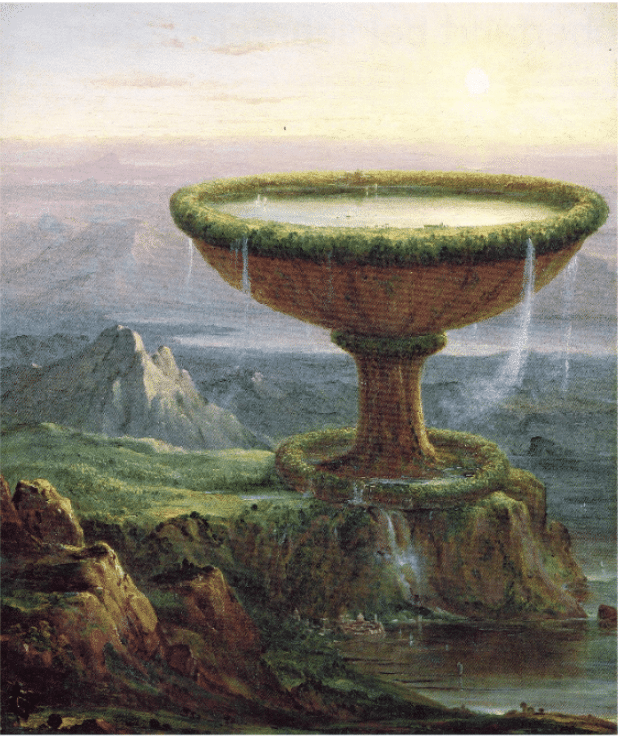
Thomas Cole, “The Titan’s Goblet,” 1833, oil on canvas, 49.2 cm × 41 cm
A giant drinking cup visually modeled after the “World Tree” of Norse mythology rises from (or rests upon) the land, catching the sun’s rays. (The Sun was a Titan in Greek Mythology by the way.)
The Metropolitan Museum calls it Cole’s most mysterious, a work that “defies full explanation,” a landscape within a landscape: the fantastical goblet stands on conventional terrain, but its inhabitants live along its rim in an idyllic world all their own. Lush verdure covers the brim, broken only by two tiny buildings, a Greek temple, and an Italian palace. Where the water spills to the ground below, grass and a more rudimentary civilization springs up. Multiple interpretations abound.
Perhaps the “world within the world” is meant to convey a relationship between time and eternity, the real and the imaginary. Maybe it’s a painting of the elevated but vanished peace and beauty of the ancient classical world and, below it, the “new” world of Cole’s time evolving in its shadow.
But even if so, what is Cole saying? It’s one of those paintings you have to interpret for yourself. And why not? After all, as Henry David Thoreau once said, “This world is but a canvas to our imagination.”