“The artist’s task is not the faithful representation of air, water, rocks and trees, but rather his soul, his sensations should be reflected in them. The task of a work of art is to recognize the spirit of nature and, with one’s whole heart and intention, to saturate oneself with it and absorb it and give it back again in the form of a picture.” – Casper David Friedrich (1774-1840)
Caspar David Friedrich seems to cast an ever longer shadow, not only over the history of Western landscape painting, but over how we think of humanity in relation to the awesome power and sometimes bright, and sometimes dark, beauty of nature.
At times called “the inventor of Romanticism” (which spans the late 1700s through the 1850s) Friedrich epitomizes the period. Friedrich, the Romantic artist par excellence, positions himself as an inward-looking pilgrim in pursuit of the mysterious and the mystical in nature and humanity. Romantic art and literature often serve as both windows into an imaginary world and mirrors of our longing to transcend the trivial and the ordinary and to embrace on one hand wholeness and on the other, the unknown.
Friedrich is the subject of an exhibition at the Metropolitan Museum of New York that’s nearing the end of its stretch (it’s got about three weeks left as of this writing). The exhibition, “Caspar David Friedrich: The Soul of Nature,” is the result of savvy curators taking advantage of an unusual opportunity to bring several of Friedrich’s masterpieces together from Germany and elsewhere – something very unlikely to occur again in our lifetimes.
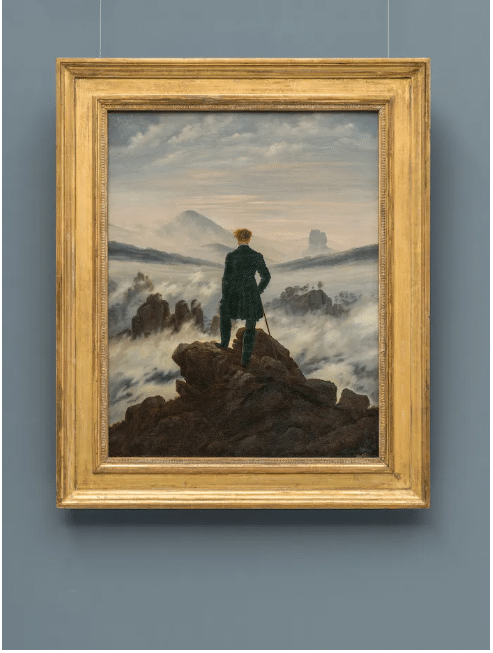
Caspar David Friedrich, The Wanderer Above a Sea of Fog, 1818
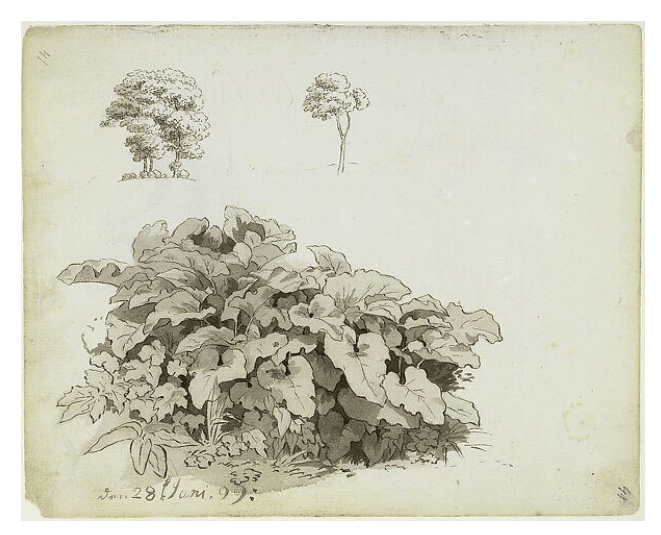
As a student of the academy, Friedrich made many studies from nature, which he thought of as “portraits” of trees and rocks and vegetation. He would use those sketches in studio paintings throughout his career.
But he quickly passed from copying nature into a more personal interpretation in which he could express what he felt as well as what he saw. His breakthrough painting was the large (more than three-feet wide) “exhibition watercolor” View of Arkona with Rising Moon of 1805-6. This was something new, and the academy at once embraced the work’s innovations: the quiet mood of twilight, atmospheric ink washes, infinitely subtle tonal gradations, and the feeling evoked by situating the viewer within a much larger sense of scale.
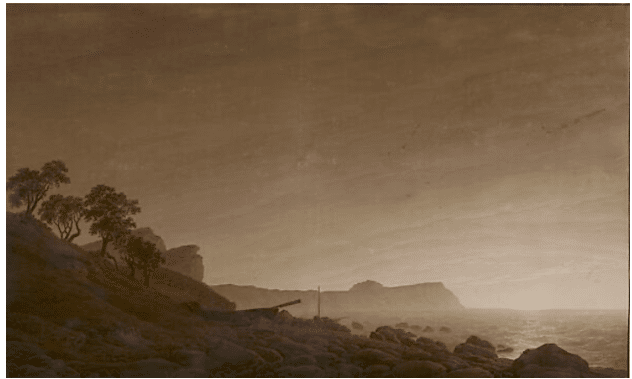
Casper David Friedrich, View of Arkona with Rising Moon (1805-6), 24 × 39 3/8 in, brown ink and wash over pencil. Albertina Museum. Vienna
The location, Cape Arkona on the German island of Rügen in the Baltic Sea, has significance as one of the last strongholds in the region in which a temple stood for a people who practiced a form of nature spirituality. The theme of humanity’s estrangement from and longing for wholeness with nature would remain central to Friedrich’s work and all of Romanticism.
This was technique put to the service of a new sensibility, a new idea of what landscape painting could be, and a novel sense of feeling entering the visual art of the time. It inaugurated a new way of looking at art in which the viewer participates imaginatively in the work. “The glow is of spiritual as well as natural, misty light,” says Met curator Jason Rosenfeld. “Not long after this, we get Wanderer above the Sea of Fog” (described below).
The star of the show, the one that’s drawing the most onlookers, is the powerful and revolutionary The Monk by the Sea. We devoted an issue of Inside Art to that one remarkable painting, which you can read here.
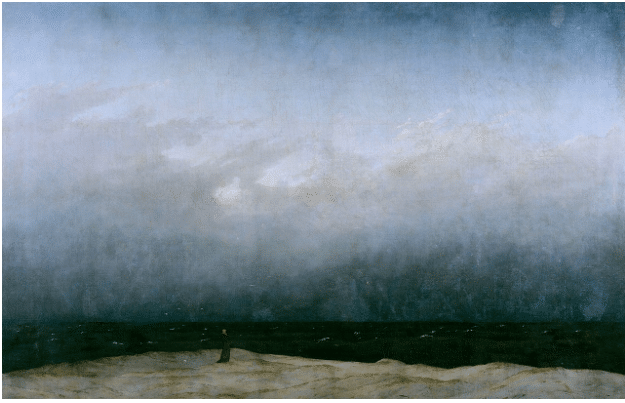
Caspar David Friedrich, The Monk by the Sea, 1808-10 which lives in Nationlgalrie, Berlin (The Brooklyn Rail has a nice essay and a review of the show that says it all better than I’m doing. It’s over here.
Met curator Alison Hokanson calls The Monk by the Sea “incredibly radical for its time” in part for its minimalism and for its open-endedness. “A painting in 1810 was supposed to convey a moral message or a narrative story, but not in this one. The viewer needs to complete this painting with their own emotions. It’s thought to suggest a sense of existential crisis, because there is so little to grasp on to.”
After a strong start and a fairly successful career, Fridrich fell out of favor later in life. Misunderstood and all but rejected by his contemporaries, the artist would die obscure and half-mad, gloomy and paranoid that his closest caretakers were hatching evil plans against him.
Today, Friedrich is everywhere, if you know how to look for him. His positioning of human figures against vast and moody atmospheric nature-scapes appears again and again, especially in Hollywood movies.
The Wanderer Above a Sea of Fog (above) appears constantly on the cover of novels and philosophy textbooks. In this painting, Rosenfeld says, we experience the immense grandeur and great age of solid rock, yet it is dissolving in an evanescent mist.” Between material and immaterial then, we find – humanity. “It isn’t a painting of a religious experience, per se,” the curators point out, “because by its nature it’s multifaceted in what it can mean.” Rather, it is hints at the human condition, as a wanderer “between the worlds,” that is, a figure poised between solid ground and heavenly ethers, between eternity and time, the spiritual and the mundane, the sacred and the profane. This painting depicts the human story, and what is being told is the epic of humankind.
Perhaps that’s why Friedrich’s stature continues to rise. As art historian Stephanie Buhmann has remarked of Friedrich’s paintings, “The significance they held for their historical, spiritual and political moment seems to appeal just as strongly to our own yearnings and fears, attesting to their timeliness in another uncertain age.”
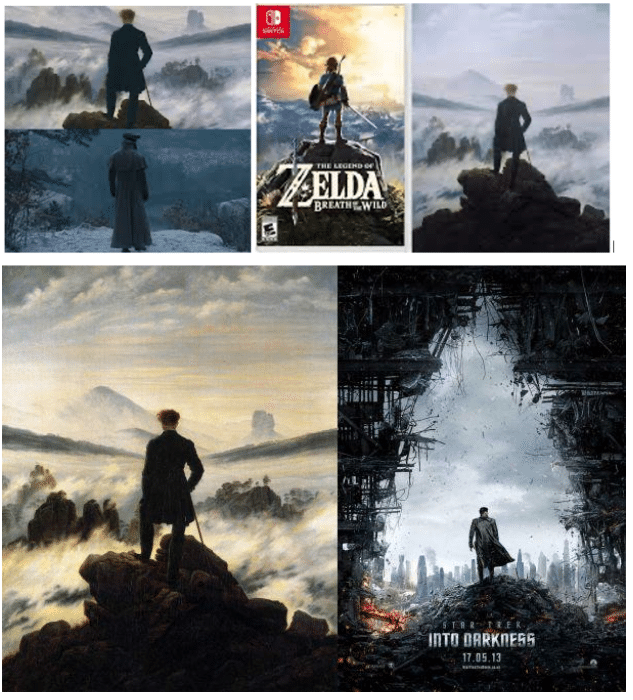
Two hundred years later and still relevant (r-l: Friedrich (1820) vs. Nosferatu 2024, Zelda the video game, & Star Trek, Into Darkness.
Artists today continue to explore the truly endless possibilities of landscape painting in so many interesting ways, and many of them teach. Check out some high-quality landscape painting videos here.