For more on this painting, go here.
We continue our look at the first exciting period of “homegrown” art and ask the question, What happened to the Hudson River School with yet another question:
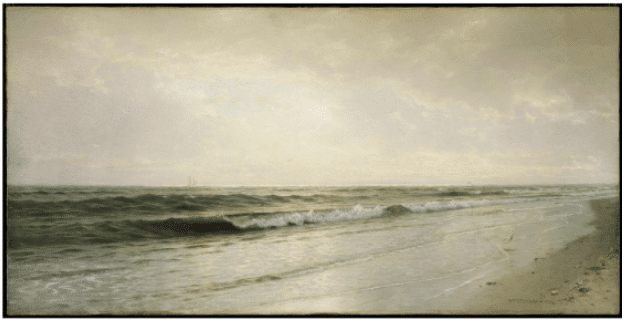
What can we make of the difference between the painting by William Trost Richards titled “Quiet Seascape” (above) and the one titled “Weatherbeaten” by Winslow Homer (below), painted closer to the 20th century, a decade or so later?
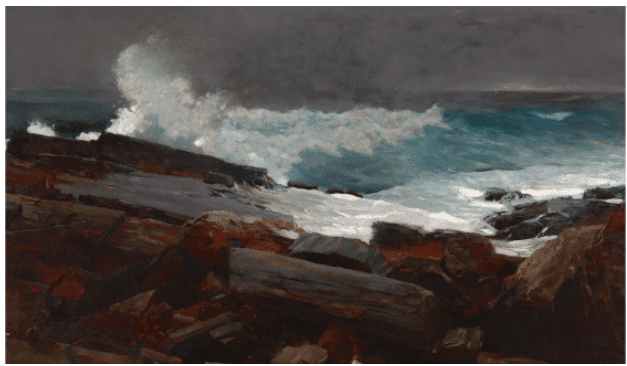
Winslow Homer, Weatherbeaten, 1894, oil on canvas, 28 1/2 x 48 3/8 inches. Portland Museum of Art (Maine). Image courtesy of Luc Demers
In Richards’ sweeping vista (top of page) we get diffuse golden light, soft lines, majestic open space, and calm. In Homer, we get an oppressively stormy sky, sharp angles, an almost claustrophobic in-your-faceness, and raw confrontation with the primal forces of nature.
The eminent American art historian John Wilmerding said of the late period of Homer’s life and work, spent on a spit of rocky land in Prout’s Neck Maine: “In that studio, Homer was able to face the infinite as his own life moved into the older years. That landscape gave him the sustenance to face the largest questions of life and the imminence of death itself.”
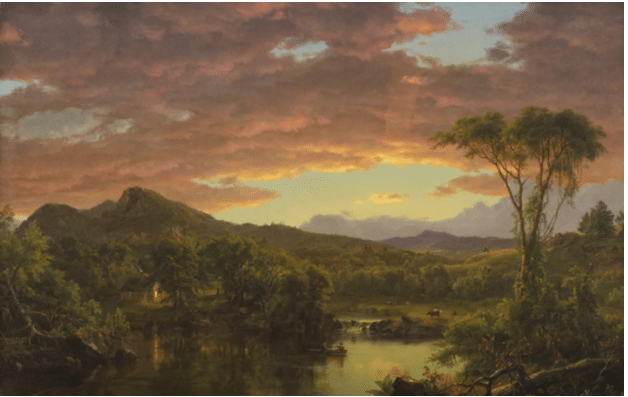
Frederic Edwin Church, “A Country Home,” 1859, oil, 81 3/10 × 129 1/2 in
Dating to just about the period of the American Civil Ware, Wilmerding and other art historians note a major shift away from the large-scale celebration of the grandeur and divinity of the “New Eden” of North America (such as we see in Church’s “A Country Home” above). There are probably numerous reasons, but that’s about when we start to see smaller, less grandiose, less wildly optimistic landscapes gaining favor. One artist who changed with the times is Hudson Rive School painter Edwin Church.
In response to the patriotic fever that swept the North, in May 1861, Church painted “Our Banner in the Sky” (below) – a sunrise resembling a Union Flag. A few weeks later, Church dashed off his celestial vision of a Union flag composed of parallel bars of scarlet clouds parting to reveal a starry firmament. Union outrage at the Confederate assault on Fort Sumter, South Carolina, had been stoked by an insult to the nation’s flag, torn by shell fire even after the white cloth of surrender went up. Church’s dealer titled the work Our Banner in the Sky and had Goupil & Co. issue it as a chromolithograph that sold briskly in the following months. He painted numerous sunsets at this time, shot through with melancholy and a brooding silence.
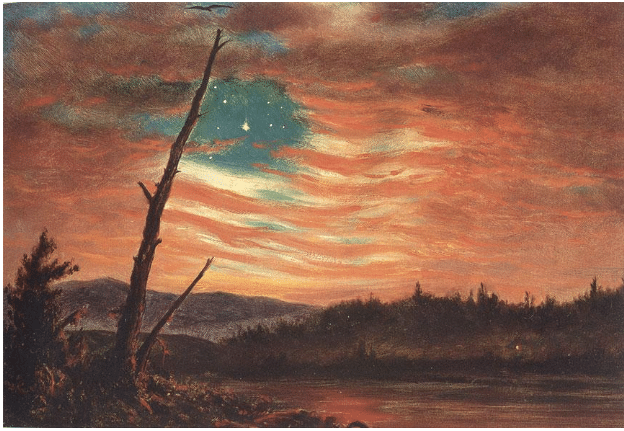
Chromolithograph, published by Groupil & Co., 1861, oil over chromolithograph, after Frederic Edwin Church, Our Banner in the Sky, April-May 1861, 7 9/16 x 11 3/8 in., OL.1986.29, Collection Olana State Historic Site, NYS OPRHP
Other, younger artists, such as Winslow Homer, turned away from the cinematic vistas of the old guard for more “psychological” work that explored the interior worlds of Americans rather than the land itself. Homer had seen the war firsthand as an enlisted man of 25 years of age in 1861. He sketched throughout the war and after turned his sketches into finished paintings. But his work for years after that went beyond documentation, history painting, patriotism, or mediations on warfare.
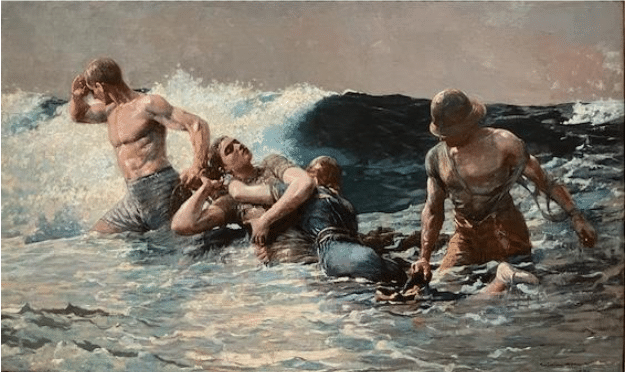
Winslow Homer, Undertow, 1886
In the painting “Undertow,” (above), three men struggle against a powerful tide as they try to save a woman from being pulled out to sea. The inspiration for it likely came in 1883, when Homer witnessed an event near Atlantic City, New Jersey, in which rescuers hauled ashore two women weighted down by their waterlogged bathing dresses, in danger of being pulled beneath the waves by an undertow (thank heaven for bathing suits, right ladies?).
The perilous struggle of Homer’s figures suggests human vulnerability in the face of the sea’s awesome power, a theme that informed Homer’s best paintings for the rest of his life.
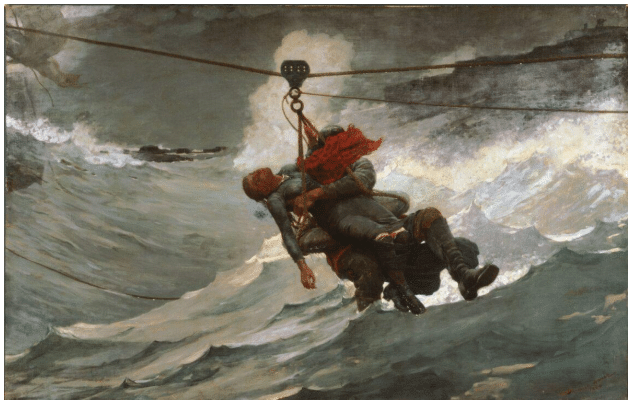
Winslow Homer, “The Lifeline,” 1884, oil on canvas, 28 5/8 × 44 3/4 in., Philadelphia Museum of Art
In the painting “The Lifeline” (above) Homer depicts the dangerous process of getting someone to safety during a storm. Dead center we see a man and a woman entangled with each other dangling from a harness on a pully as if suspended halfway between life and death.
On a smaller more intimate scale, you might say, Homer taps the same kind of deep archetypal human experiences of mortal struggle, courage, and heroism in the face that he encountered on the battlefield. In both of these sea paintings, the theme is the same: nature is neither beautiful or divine, and humanity is vulnerable to the impassive forces the move around and through us and care capable of overwhelming us at any time.
A page had turned, both in history and in American art. So, it might not seem so odd that George Inness’s most famous painting of Niagara Falls (he depicted the falls in nine versions in oil and watercolor) differs from anything the Hudson River Painters had produced. This Niagara features the very prominent and very modern plume of a (northern) industrial smokestack jutting above the horizon like a ship’s mast, spewing a pinkish-black smoke into a dense gray sky. It’s 1889 – the wilderness is done; human civilization dominates from here on in.
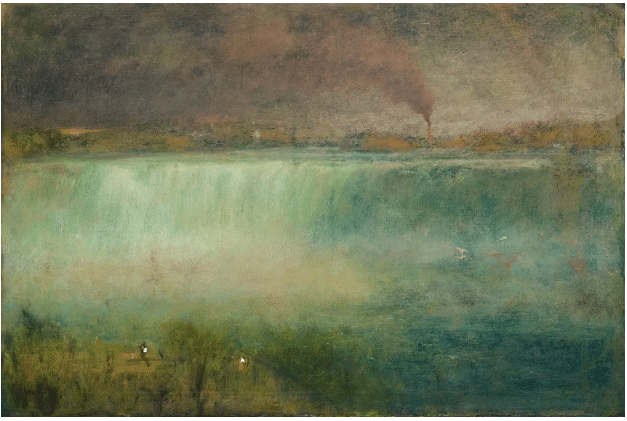
George Inness, Niagara, 1889, oil on canvas, 29 7⁄8x 45 in. (76.0 x 114.3 cm), Smithsonian American Art Museum.
Plenty of beautiful landscapes and seascapes also went on floating into American parlors and museums as French Barbizon and Impressionist styles infused American painting during the 1880s and ‘90s. But in 1913, on the eve of another dire and bloody war, European modernism exploded onto the American art scene and that changed everything.
The Armory Show in New York, which also traveled to Boston, and Chicago, introduced revolutionary ways of thinking about painting which led ultimately to abstraction, pop art, and minimalism. That’s where all the excitement and critical attention was going, and suddenly the Hudson River and Tonalist school landscapes looked behind the times, naïve, and worst of all, derivative of out-of-favor European models. So museums put them in storage or sold them off. It wasn’t until the 1980s and ‘90s, about a hundred years after the decline, that numbers of people became interested again in those forays into what Cole had once called the “beautiful and sublime” in American scenery.
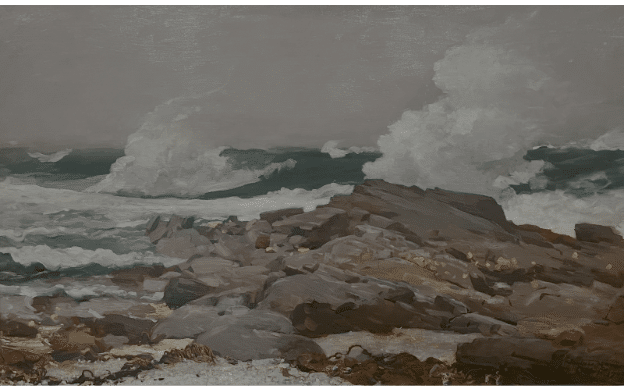
Winslow Homer, “Eastern Point,” 1900, oil
Painting seascapes is not as difficult as one might think. Don’t believe me? Check out these teaching videos from professional artists who have mastered and made careers of rendering the ocean right here.